Showing posts with label 2003. Show all posts

Sunday, 8 June 2003

Graeme Wend-Walker 2003 (2)


From: Graeme Wend-Walker
To: The Kraken
Sent: Sunday, June 08, 2003 3:01 PM
Subject: [the-kraken] The International Fork You Ate

Greetings to awl!

I haven't posted to the Kraken for about two months. But I did, during that time, meet a few of you, as I wended my way around the world. Special greetings to those of you I was able to meet. You know who you are (at least as well as anyone does).

As an adjunct or appendix or (forward-lookingly) aperitif to our annual event, I remembered the fork you ate, and cast yellow paper into several corners of the world. Follows my belated report:

Whatever my original plans, once en route I found myself disinclined to leave yellow paper in public places. Partly because they were not "my" public places any more, partly because I was travelling in a time of war and unease. Partly because I felt, as a traveller, more than usually between things, and that's where I wanted to leave yellow paper; not thrust into the world, but left quietly in places which, as a university student, I am required by law to refer to as interstices. And partly because the quotes I had taken with me began to seem to be of a piece, and seemed to me to want to address themselves to other travellers, rather than to locals. So I left them in the hotels I stayed in, in drawers and wardrobes, to be found I hope by other unusually in-between people. And perhaps then to make their way even further afield.

Here are the quotes I used:

The world vibrates like a crystal in the mind; there is a frequency at which terror and ecstasy are the same and any road might be taken.


- The Medusa Frequency


I tell you what I have paid years to learn: everything that is found is always lost again, and nothing that is found is ever lost again. Can you understand that?


- The Lion of Boaz-Jachin and Jachin-Boaz

More and more I find that life is a series of disappearances followed usually but not always by reappearances; you disappear from your morning self and reappear as your afternoon self; you disappear from feeling good and reappear feeling bad. And people, even face to face and clasped in each other's arms, disappear from each other.


- Fremder


And here are the places where yellow paper was left, some places where people and things might be lost, found and dis/appeared, and from where any road might be taken:

Quails Inn Hotel, San Marcos, California, USA

USA Hostel, San Diego, USA

Chelsea Centre Hostel, not in Chelsea at all but in the East Village, New York City, USA

Hughes-Parry Hall, Bloomsbury, London, England

Ngoc Mai Hotel, Ha Noi, Viet Nam

Princes Hotel, Cat Ba, Ha Long Bay, Viet Nam

Old Darling Café, Ha Noi, Viet Nam


Kind of nice to be back. Hope everyone is well.

World being,

Graeme

Tuesday, 4 February 2003

Richard Cooper's Hoban Adventure - introduction

Skip intro and read the full report

The idea for a journey around Russell Hoban's London came to me while I was at work about a week beforehand. I’d already booked "SA4QE Day" off because I’d had the idea to hire a glockenspiel and busk it around London whilst selling yellow-paper poems, in an homage to Kleinzeit, but for various logistical and financial reasons (i.e. I am a complete coward) it couldn't be done. I was therefore left with a whole Hoban day off and nowhere to go – or rather everywhere.

Russell Hoban came to London in the late 1960s, attracted by the atmospheres evoked by such writers as MR James and Joseph Conrad. He originally only intended to live in the capital for a year or two, but ended up staying the rest of his life. (He’s still very much with us, but I doubt he’s likely to leave now.) Since arriving he has written with great passion and accuracy about the city in almost all his adult novels, from Turtle Diary to The Medusa Frequency and most recently The Bat Tattoo. The thought struck me that, as a native Londoner and the only declared London resident on The Kraken, the most appropriate thing for me to do this year would be to pay a suitable homage to Hoban’s London in honour of both his and my own love for the city. There was no shortage of locations; perhaps I could choose two or three and have a relaxing day out, returning home in time to do a bit of writing about it and a leisurely dinner with my wife - a truly appropriate way to spend SA4QE day. Then again, would two or three locations be enough? Couldn't I fit in a few more? How many were there, anyway?

Still sitting at my desk at work (I’m nothing if not impetuous), I made a list of as many London locations that feature in Russ’s books as I could think of. Without having access to the books I counted at least a dozen, including London Zoo, from which William G. and Naeara D. of Turtle Diary released their turtles, the bank of the Thames by Putney Bridge where Herman Orff first meets the head of Orpheus in The Medusa Frequency, and of course Fulham, where many characters from several books (including William and Herman), as well as Hoban himself, live. It didn't seem unreasonable to go to all of them, and do a special feature on the whole thing for the site. When I got home I took all the books which I knew contained London references (I should point out that a minority, such as Riddley Walker, exist completely independently of the capital) and started skimming through them to get as full a list as possible.

Several highly satisfactory hours later, I had a list of no fewer than 40 separate locations. I had no idea how many of these I could physically visit in one day, but I reasoned that if the point was to simply pass through and record my presence with a photo and some yellow paper, I could surely do quite a few – especially as I wouldn’t be walking everywhere, but taking the Tube (traditionally the preferred mode of transport of all Hoban characters) wherever possible.

I then sat down with this list and my old, battered London A to Z - printed in 1990, London residents will be amused to learn it shows Battersea Power Station as "The Battersea Theme Park (opening 1991)" - and highlighted on it the various locations and their respective Tube stations. In most of his books, Russ gives directions to London locations which are geographically exact, but in some cases I had to check the exact address of a shop or church with the help of no less appropriate authorities than the Yellow Pages and Google.co.uk.

Having done that, all that remained bar the shouting (as my feet exploded) was the simple matter of putting the locations into some kind of logical order so I wouldn’t be going back and forth across the city and re-treading old ground unnecessarily. I knew already that I should start by Putney Bridge, preferably between six and seven in the morning, since that was the time of day when Herman Orff found the head of Orpheus in the mud, and apart from anything else if I went to that spot much later I might not be able to get down to the actual mud because the tide would have come in. Being a morning person, I had no problem with the early start – on the contrary, I love that early-morning-time before the rest of the world drags itself up and everything becomes boringly normal. In any case, I had no choice; being up at that time was essential if I really was to visit all these locations in one day.

There were any number of possible routes I could follow, but the one I settled on from Putney took me through Fulham, Parsons Green, Hammersmith, South Kensington, Victoria Embankment, the South Bank, Trafalgar Square, Leicester Square, Camden Town, Islington, Tottenham Court Road, Bloomsbury, Covent Garden, Soho and Tower Hill. Some repetition couldn’t be avoided, and some decisions on the ordering of locations were determined less by how close the locations physically were to each other than by how conveniently they were connected by Tube stations. At this point in the scheduling I also dropped half a dozen provisional locations from the list because given the limited time-frame, I could only visit the more essential landmarks.

I then attempted to plot a time-schedule for travelling between and visiting each location, and although I realised that this would probably fall apart sooner rather than later on the day itself it was important to get an idea of whether the whole thing was possible or not. I worked out that if I got to Putney Bridge by oh-seven-hundred hours (military vocabulary seemed essential) I should be able to do the whole thing with an hour for lunch and be finished by eighteen-hundred.

I put the finishing touches to my schedule shortly before leaving for work on Monday morning. It was only then that I realised that I needed to decide on the yellow paper quotes I would drop, and where. The obvious idea was to find an appropriate quotation for each location, which on the face of it didn’t seem too difficult because it was the mentioning of the locations in the books which had inspired the whole journey, and I’d already marked most of the mentions in the books themselves for easy reference later. However, going through all the novels to find the quotes, as well as typing them out (like Dave Awl, my handwriting is worse than the average doctor’s) quickly became daunting, especially as I had a full day’s work to do on Monday and couldn’t do it at home because my printer was knackered. I reasoned the best thing to do would be to take the books with me to the office and work it all out there during a convenient break. In the end I not only didn’t have time to type up my quotes, but having written about ninety-four summaries of articles about pensions I simply couldn’t face any more typing anyway. Hang on, I reminded myself; I work for a press-cuttings agency, where newspapers and magazine articles are cut out and mounted on a 24-hour basis. All the equipment was there. I photocopied the actual quotes straight from the books, cut them out neatly, glued them to sheets of paper, and then photocopied those onto sheets of yellow paper. (I should add for the purposes of copyright that these copies were the only ones made, and expressly for the purposes of this feature.) While I was doing all this my Hoban-free colleague Rob asked what I was doing. I showed him my planned schedule and told him what it was all about. “You’ll probably think I’m crazy,” I said, “and I probably won’t manage to complete the whole thing, but it’s a nice idea and I’m very excited about it.” He nodded approvingly at the list of landmarks and said, “Actually, it sounds like a really interesting thing to do on your day off.”

I lugged the whole lot home, ate my dinner, and with half an eye on Martin Bashir’s very strange interview with Michael Jackson on ITV, I sorted the quotes into the same order as the locations on my schedule so I wouldn’t have to rummage around on the day itself. The mixture of typefaces as I went through the pages looked interesting and mysterious, like a ransom letter in slow motion. I’d found about thirty location-specific quotes, and maybe another dozen with general references to London which I planned to distribute randomly. On the bottom right hand corner of each sheet I wrote simply the SA4QE acronym; I didn’t have time to write out the whole internet address, and I thought it would make the finding of the quotes more interesting in any case; all anybody had to do to find out what it was all about was enter “SA4QE” into any decent internet search engine and they’d be directed straight to the site.

By the time I’d finished sorting everything out, and - having exchanged incredulous sentiments about the Michael Jackson programme - my wife and I had gone to bed, it was gone eleven. I’d set my alarm for 5.30 and was worried I wouldn’t get enough sleep, or that I’d sleep through the alarm, or ignore it and turn over, in any case getting angry with myself for ruining the whole day. In the event, it was very much like Christmas Eve; my mind was still racing when my head hit the pillow, and I had a sleepless period of an hour or so because of the excitement of it all. In the end the alarm went off and I got up immediately, wide awake and ready to go. I had some cereal, tea and toast, checked my email and posted my birthday greeting to the Kraken – a cheeky list of anagrams of "Russell Hoban" that produced such gems as “Ron Sable-Lush” and “Rosa Bushnell”.

I dressed warmly and packed a rucksack with sandwiches, a bottle of water, a bottle of orange juice, Russ’s birthday bottle of wine on behalf of the Kraken which I was to drop off at his house, a couple of Geobars, a Chunky Kit-Kat, a packet of Hula-Hoops, spare socks, our digital camera inside its makeshift case of a sock (we never seem to get around to buying a proper one), an umbrella, and of course the yellow paper quotes themselves. I’d made a tape the previous evening from a Thelonious Monk CD called Monk’s Mood which was related to a particular location and Hoban reference, but suddenly realised my walkman didn’t work. I had another one, although it was a recording walkman and a bit chunkier, but I took it anyway, together with a blank cassette, reasoning it would be handy for making notes which I wouldn't then have to attempt to decipher. I already had my regular notebook in my overcoat pocket - a Roaring Spring® 3½ x 5¼ 50-sheet stiff-backed Mini Legal Pad, which my friend and fellow Hoban fan Elizabeth had given me for Christmas to bring me luck with my writing. The tiny pad had caught her attention because the paper was yellow, but she’d also realised as she was wrapping it that Roaring Spring was based in Pennsylvania, the same state that Russ comes from, so it was clearly made for today’s job.


I had a dilemma about which shoes to wear. Obviously I needed a good pair for walking all day, but I couldn’t decide between a pair of old boots, which would be very comfortable, sturdy and waterproof but looked very scruffy, or a pair of shoes with Doctor Marten soles which would look more respectable but wouldn’t be quite as tough as the old boots. In the end I decided on the shoes, since there were two essential pubs on my list, both of which had been well-documented by Russ as having signs outside saying PERSONS WITH DIRTY CLOTHES, BOOTS OR SHOES WILL NOT BE SERVED HERE, and I had a Dickensian mental image of an irate landlord hauling me off the premises by my ear and the whole odyssey ruined. Of course, I was overreacting; those notices were really no more than a relic from a bygone age, and anyway my boots weren’t dirty, they were just a bit worn out. In reality, I realised as I tied and double-tied my shoelaces, the landlord fear had been a way of convincing myself that it was OK to choose “smart” over “practical”.

I kissed my wife goodbye and went out into the street. It was just gone six-thirty; I’d been worried as I checked my email that I’d miss my dawn rendezvous with the low-tude mud, but it was still dark and beautifully quiet. I hadn’t been out at that time in the morning for years; although I usually get up at seven every working day, I don’t start work up in central London until midday, so I rarely have any reason or motivation to be outdoors before eleven, let alone dawn. I’d forgotten how peaceful and special it was. The early-morning black of the sky is different from the late-night black, and not just because it’s ever-so-slowly changing to blue; the air smells different, the houses and buildings stand differently, streetlamps and lights in windows shine differently. Walking over Richmond Bridge and down Richmond high street, the only traffic was formed of Royal Mail vans trundling about in pairs, their redness radiating the reassurance of a social infrastructure without the chaos that would soon descend on the city in the form of gridlock.

At the station I bought a peak-time Travelcard which would allow me unlimited use of all trains, Tubes and buses within Central and much of Greater London for the whole day. Given how much use I was planning to make of it, at £7 it felt like a bargain, especially considering that the minimum price of a single bus journey is 70p and a single Tube journey twice that. The Travelcard itself has been around for years, and after 9.30am is even more of a steal at £4.50, but the peak-time version is only a recent innovation, and not before time if you ask me. Until it was invented, day-trippers like me heading out before 9.30am would have to buy a ticket to a particular destination via a specific mode of transport, which had always seemed to me criminally restrictive.

At 6.45 I boarded the first Tube of the day, from Richmond to Putney Bridge via Earls Court. The yellow and orange of the carriage décor was intensified by the still-dark sky. The gently-simmering silence of the train as it waited to leave the station was broken only by the regular coughing of a thin man opposite me reading the sports pages of The Sun. A lean-faced young guy with a shaved head and a toolbox at his feet and nothing to read looked over at him from time to time; the older man’s coughing seemed automatic, like a machine, so much so that the cougher himself had long since stopped noticing his clockwork expectorations. Above the head of the toolbox man, between the adverts for travel insurance and car insurance, was one of the Poems on the Tube, this one by Rafael Alberti:

The waves, blue walls
of Africa, go and come back.

When they go...
Ah, to go with them!

Ah, to come back with them!
When they come back...

...which seemed a good omen for the journey ahead.

* * * *

Further reading: Richard's 28-page report of the journey, complete with photos of each location, the quotes he chose and a personal commentary, is posted on this site in the format of one post per location. Start at the first stop in Putney and work your way across London by clicking on 'next stop' at the bottom of each post.

Even further reading: Richard's adventure was mentioned in a feature about SA4QE in The Independent on Sunday in February 2004. Read the article

Disclaimer: The list of landmarks from Russell Hoban's London visited in this feature was not meant to be exhaustive. This was a one-day attempt at the Riddley Walking Challenge Cup, and as explained above, some locations were decided upon (or against) by the logistics of getting from “A to B” within a reasonable amount of time and without too many flashes of pain in between...

Richard Cooper's 2003 Hoban Adventure 29/28 (sic)


My journey was over, all bar the shouting; now all I had to do was get home. I’d deliberately made Tower Hill my last stop so I could catch a District Line Tube directly to Richmond. I crossed the road from All Hallows and staggered to Tower Hill station, outside which a group of tourists were being taken on some kind of guided tour. I wished I’d had the energy to tag along, but it was no use – I had to put my feet up and get home, in that order. A Richmond train arrived at the platform almost immediately I descended into the station and I sank into a seat like someone three times my age. I flicked through a copy of the Evening Standard someone had left on the seat, whose headline told a tragic story of a promising American artist who’d been murdered that morning while she jogged in Hackney. The news made the “Birdwood” exhibition of platform sculptures at Gloucester Road all the more poignant. Opposite my seat, squeezed again between more adverts for mortgages and travel insurance, was another of the Poems on the Tube, this one “Bonnard” by Elizabeth Jennings. I inserted the quote from Angelica’s Grotto in a random page of the Standard which I then left on the seat next to me; technically the train wasn’t going to Fulham, but it was on the right lines – the District Line, to be precise, which is something akin to an actor who makes cameo appearances in almost all of Russell Hoban’s books. The line itself takes in a great swathe of London, from the affluent suburbs of Richmond, Fulham and Wimbledon in the west to the less exclusive towns of Plaistow and Upminster in the east, all of it via Westminster, Victoria, Sloane Square and of course Monument and Tower Hill in the City. The Wimbledon branch of the line itself runs directly past Russ’s window in Fulham, as it does the windows of many of his characters. I might be a “west Londoner” but whenever I’m on the line I like to look up at the map and say the names of some of the east London and Essex stops to myself: “Dagenham Heathway”, like the name of a thriller writer; “Stepney Green”, a prime candidate for a regular in the house band at Ronnie Scott’s; “Bromley-by-Bow” was Bromley Bybow, a character from a fictional landscape somewhere between P.G. Wodehouse and J.R.R. Tolkien. And Upminster – Lord Upminster to you, guv; another of my favourite people, the late, great songwriter and professional geezer Ian Dury. I often dreamt of him acting in a dramatised version of one of Russ’s novels; sadly that won’t happen now.

As the train approached Richmond and my last stop of the day, I thought again about Russ’s visit to the Old Town Hall there on 22nd November 1999 for a reading from Angelica’s Grotto. I remember the precise date because I bought a copy of the book and he signed it for me TO RICHARD COOPER, BEST WISHES FROM RUSS HOBAN 22-11-99. It was the first time I’d met him and I’m glad it wasn’t the last. Criminally, there weren’t many people at the reading, but I was there with my dad, a big fan of The Medusa Frequency via the writings on mythology by Jung and Joseph Campbell, and two friends who were also admirers. I felt a bit inferior to them at the time because they’d read Riddley Walker and I hadn’t, but I made up for this transgression fairly quickly after the reading. Russ was dressed all in black except for a multi-coloured knitted waistcoat. It was very funny to see him, a short man of seventy-three with a small beard and no moustache, standing at the lectern and reading with a perfect deadpan expression the description of Harold Klein from the first page, “He was a small man of seventy-two with a small beard, no moustache”. He read the first few chapters and then excerpts from later chapters, prior to taking questions from the audience. Before he did this he swapped his reading glasses for his lissening glasses, a pair with tiny microphones attached to the arms. He talked about his writing technique of “constantly returning to page one”, which we agreed later must have required the patience of a saint. I asked him how he knew when one of his ideas was going to become a novel: “If I can write fifty pages, I see if I can take it up to a hundred pages,” he said, “and then I see if I can take that up to a hundred and fifty pages and so on.” It sounded a wonderfully simple technique for books of such “controlled complexity”. One of my friends asked him quite a lot of questions, among them “Do you feel deracinated when you’re not writing?” to which Russ replied, “When I’m not writing, I simply feel ill.” This got a big laugh and the question and answer session was rapidly terminated by the host from Richmond Council’s arts department who said, “I think considering that Russell does, as he says, share several of Harold Klein’s infirmities, we ought to give him a rest. Thank you very much.”

The train drew in at Richmond and I prepared myself for the last haul, a ten minute walk home. Before I alighted I dropped the last quote of the day on a seat by the door:


Outside Richmond Station a bus was just about to depart but I didn’t have the energy to make a run for it. I staggered down the high street, past the Old Town Hall and over Richmond Bridge, dreaming of another glass of wine and a hot bath the way men who’ve been crawling across the desert fantasise about a glass of water. And when I finally got home, I found, stacked against the front door in what could be described as either Jungian synchronicity or a Pythonesque joke, four copies of nothing less than the new edition of... the Yellow Pages.

No, really.


That's all folks!

Richard Cooper's 2003 Hoban Adventure 28/28

19:27

All Hallows by the Tower

(The Medusa Frequency)


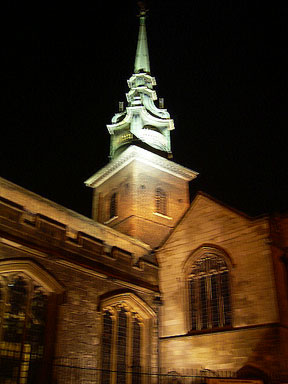
I allowed myself a good half-hour to mull over my wine in the Cheshire Cheese before heading off for my last official Hoban stop, All Hallows by the Tower. I traced my route back up Savage Gardens to Tower Hill station but even with my map couldn’t work out exactly where the church was. The Evening Standard vendor by the entrance to Fenchurch Street Station – and a Londoner too!! – directed me across the cobbled square, over the main road and “up to the right a bit”. True enough, here it was – and a beautiful church too, rising up goldenly in the night in a warm rhyme with the Tower of London and Tower Bridge in the distance. Sadly it was closed, so I couldn’t venture into the crypt in the way Herman and Melanie had done, but I popped the quote through the letterbox and took a hobble around the building where I took these shots. The one of the church itself is a bit blurry because I didn’t have a tripod, but hopefully the idea of the church in the night comes through.


Richard Cooper's 2003 Hoban Adventure 27/28

18:49

The Cheshire Cheese, Crutched Friars

(The Medusa Frequency)


I think Crutched Friars has to be one of the best street names I’ve heard, even in London. My blurry head mixed the word crutched with crouched and I imagined the street centuries ago populated by little tonsured, stooped old men in heavy cassocks hobbling around on their way to the London Foot Clinic. The pub was directly under the railway bridge taking trains to and from Fenchurch Street Station and there was just the one streetlamp in the vicinity, so the whole thing felt juicily Dickensian, and, by extension, Hobanesque. There was a sign on the wall under the bridge saying:

IN CASE OF EMERGENCY

If you witness a vehicle striking this railway bridge, please contact Railtrack using telephone number 01708 641225. State “Bridge strike at Savage Gardens” and quote bridge number FSS1495. Immediately afterwards inform police using 999 system.

The full Medusa description of the Cheshire Cheese refers to a décor of red and black, so I was expecting the pub to be dark and dimly lit with small knots of old men mumbling in corners smoking Golden Virginia and playing bridge. Whether Russell Hoban embellished the interior to give it more atmosphere for the novel or whether it had had a refit since the mid-eighties I couldn’t be sure, but the words red, black and dark were not the ones that immediately sprang to mind as I walked in. It was certainly welcoming, but kind of yellow and green, quite bright and a little on the hard side, with one of those polished wood floors that people’s voices and juke-box tunes bounce off rather than be absorbed by in the style of the old-fashioned pubs. There were tables and chairs dotted about and at the far end of the bar an enormous TV screen was suspended. It wasn’t very busy, but almost everyone in the pub seemed to be a City type in a pin-stripe suit, and for a moment I had the awful feeling that this was an old pub that had been yuppified in the same manner lamented by the John Smith character from the Zetland Arms scene from Amaryllis. Given the suitage in the place I jumped to a conclusion and thought the screen was showing Bloomberg statistics and financial news, but on a second look it was just a sports programme, and not everybody in the pub in fact was wearing a suit. Long overdue for a drink, I was called to the bar where I stood for a couple of minutes while the single barman, a Kiwi in his early twenties with spiky hair and an animal tooth on a cord around his neck, served a group of City types who seemed to have taken up residence at the other end. I’m eternally useless at getting the attention of waiters and bar staff, and, in quintessential English fashion, I tend to just wait patiently for hours repressing my rage until I finally implode. Here however one of the City guys actually made the unheard-of sacrifice of pointing the barman in my direction, a gesture for which I was very grateful and which raised my opinion of both clientele and establishment immediately. I ordered a glass of Australian red wine and a packet of cheese and onion crisps (any other flavour seemed wrong somehow) and retired to a table. From here I soaked up the gentle atmosphere and surreptitiously inserted the previous quote about the approach to the pub from Savage Gardens into a menu of some nice-sounding pub food, and secreted this quote underneath an empty pint glass:

Of course I was hoping very much that Gom Yawncher would still be here. I realised he had technically gone the way of all flesh at the end of the novel, but on an imaginative and spiritual level he was surely still with us. The glasses were in fact collected by a man in a blue shirt but he didn’t say anything so I couldn’t gauge his accent, and he looked about 40 years too young to be Gombert himself. Then again, I reflected, there seemed to be a general lack of actors of the Gom Yawncher generation around London these days: all the bar and café staff, the buskers, the strangers on the Tube, the cashiers and attendants at the various shops and museums that I’d met today had almost all been my age or younger, and most of them weren’t from London or any region of the UK but from all across the globe. Maybe when Gombert died he was replaced by a younger, more exotic actor, one who was seen to reflect the needs of a changing society and a more demanding audience, in the same way that British soap opera characters seem increasingly to be given Croatian boyfriends and neighbours from Sicily. Then again, I had heard a rumour of a pub in Borough High Street run by a Londoner; I made a mental note to check it out another time to see if it really was true. In the meantime, I wondered what part I was playing today. I fancied myself as Michael Palin, but I realised with sadness that the role was already taken. It looked like I’d have to settle with being Richard Cooper instead.

Next stop

Richard Cooper's 2003 Hoban Adventure 26/28

18:46

Tower Hill, Savage Gardens and the Orpheus Bar & Restaurant

(The Medusa Frequency)


Heading out of Soho into Oxford Street, a public dialogue seemed to be going on in general fashion. A man in a white jacket hissed into a mobile phone, “He’s such a twat, isn’t he?”; a trendy man said to an attractive woman, “I can’t do Monday and I can’t do Thursday”; an olive-skinned man said to his friend stooping to tie his shoelaces up in a doorway, “If I want information, you should be able to provide me with it.”

In Oxford Street itself I heard a strangely familiar sound. I looked up and it was the same guy I’d passed in Exhibition Road earlier in the morning, doing his Jesus rap into his personal loudspeaker. “You’re going in the wrong direction,” came the electronically-modified Scouse accent. I’m not, I thought, I’m heading for Oxford Circus Tube. “That’s why Jesus came in the world,” he went on regardless, “to die for the sinner, and turn the sinners back into winners.”

At Oxford Circus commuters and shoppers and tourists were busy avoiding the traffic by cramming themselves slowly down a funnel of stairs to make their way home along tunnels underneath the city. I travelled south on the Bakerloo Line, alighted at Embankment, switched to the Circle Line and stood for the half-dozen stops to Tower Hill with my nose an inch away from the back of someone’s head. The journey was lengthened somewhat by one of those loud, irritating conversations that only take place between people (six teenagers in this case) who don’t have to travel on the Tube during rush-hour twice a day five days a week, and therefore are blissfully unaware of the “be unseen and not heard” commuter protocol – dubious in itself, perhaps, but not half as dubious as the lavatorial conversation they were kindly sharing with the entire carriage. I was technically on the wrong train for the quote in question but at Tower Hill there was a definite gasp of relief when this little bunch finally got off and I joined them in a squid-like many-legged movement of our own.

Getting to street level was like coming up for air. The night was fresh and crisp and all around things were lit up, from the station itself to the huge sundial outside to some beautiful buildings across a cobbled street and, across the main road, the Tower of London. A man stood by wearing a sandwich board saying SEEK THE LORD WHILE HE MAY BE FOUND. Savage Gardens was across the street – no obvious gardens anywhere, savage or otherwise, but a short lane flanked by a couple of enormous old buildings. I couldn’t imagine the modest Orpheus and Tower Bridge Club as described being held in either, but the street seemed to end so I presumed it had to be here somewhere. As I walked it suddenly struck me that all these years I’d been thinking the club was for people who play bridge; it was only now I was a short walk from Tower Bridge that I realised this was in fact where it got its name from. Well, half of it, anyway – what the Orpheus bit was about I couldn’t be sure.

I walked on a little more and it turned out that where Savage Gardens seemed to end was only where it was bisected by Pepys Street; I continued down and came upon the Orpheus Bar & Restaurant to the right – complete with the hotel-like feel described in the book – and, a little way in front of me under the rumbling railway bridge, the Cheshire Cheese. I feel I would have taken the same decision as Herman Orff, given the choice between the two. There was nothing strictly wrong with the Orpheus Bar & Restaurant – in fact they had some nice fish on the menu – but the Cheshire Cheese’s golden-glowing windows definitely beckoned. I wondered where I should drop the quote but before I’d even decided what to do with it I was through the pub’s doors and heading for the bar.


Diana Slickman 2003

I spent Russ's birthday in Rochester, NY this year. By accident, not by design. I am here in Rochester, still, performing with the theater company with which I have long been associated, the Neo-Futurists. February 4th was a very windy day here on the banks of the Genessee river, mostly overcast and snowy. I and a couple of my fellow-performers had a little outing and visited the George Eastman house which, if I may say with apologies to our host city, is one of Rochester's few attractions. It was the home of the late film-and-photographic-equipment mogul (as in Eastman Kodak), and now houses a large cinema and photographic archive. We saw an wonderful exhibit of photographs by the great renaissance man Gordon Parks and wandered around the house marveling at the number of ashtrays and curios made from animal hooves contained therein. I had my yellow paper in my back pocket the whole time, waiting for its opportunity. In the gift shop I slipped the quote in next to a book of photos by Lewis Hine, whose portraits of sweatshop children have that same quality that Vermeer's turbaned girl has, of the thing itself looking out from their eyes. The bookshelf was tightly packed, crowded with books on all manner of subjects photographic and if there was an order to it, it eluded me. Here is the quote that chose itself this year:

from PILGERMANN

To me everything is extraordinary and nothing is. Aeschylus was killed when he was hit on the head by a tortoise dropped by an eagle but that's not extraordinary when you consider that he was sitting directly below the eagle when it dropped the tortoise from a considerable height. On the other hand, that there was Aeschylus, that to me is extraordinary: that the world appeared in his eyes, that the world lived in him like the light in a lantern, that there are continually new lanterns for the world to live in, that you and I are two of them, yes, that to me is extraordinary.


Here in Rochester, I am at the mercy of library computers for my internet and e-mail access, but I look forward to going back to Chicago and reading at my leisure all of the correspondance re: this year's event. I'm so pleased that this fledgling idea has taken flight so successfully. Here's to many more!

Dave Awl 2003

Inspired by the valiant efforts of this year's other SA4QE participants, I decided to kick my efforts up a notch and do better than last year's single yellow paper left in a freezer case at the supermarket. And all in all, the evening of Feb. 4 was most productive: While my journeys weren't nearly as extensive as those of the peripatetic Mr. Cooper, I did manage to 4Qate in four separate locations and two different neighborhoods. (Yes, I've decided that the proper verb form of SA4QE is "to 4Qate" -- pronounced like "fork you ate." I 4Qate, she 4Qates, he 4Qated, we are 4Qating. Can be either transitive: "Oh yes, I 4Qated that cafe last year," or intransitive: "My assistant kept a lookout while I surreptitiously 4Quated in the poetry aisle.") And I got this year's 4Qations on film.

As I started to choose quotations for this year's yellow paper, I found myself drawn to a number of quotations that seemed to revolve around a common axis I couldn't quite articulate -- something about time, history, and one's place (or absence) in one's own story. I got interested in arranging a series of quotations to form a sort of oblique narrative, like finding a story in a sequence of Tarot cards.

Once again I was fussily disappointed by the yellowness of the yellow paper I was able to obtain locally. Compared to the more relaxed and self-possessed yellow paper on which I have letters from Mr. Hoban, the yellow paper I am stuck with seems to be trying too hard, an insincere look-at-me "yellow" as opposed to a quietly thing-in-itself yellow. Never mind, get on with it.

I finally settled on the following six quotations, in this order:

from TURTLE DIARY:

Two of the turtles at the aquarium are green turtles, a large one and a small one. The sign said: 'The Green Turtle, Chelonia mydas, is the source of turtle soup...' I am the source of William G. soup if it comes to that. Everyone is the source of his or her kind of soup. In a town as big as London that's a lot of soup walking about.

from PILGERMANN:

A story is what remains when you leave out most of the action.

from FREMDER:

More and more I find that life is a series of disappearances followed usually but not always by reappearances; you disappear from your morning self and reappear as your afternoon self; you disappear from feeling good and reappear feeling bad. And people, even face to face and clasped in each other's arms, disappear from each other.

from PILGERMANN:

One assumes that the world simply is and is and is but it isn't, it is like music that we hear a moment at a time and put together in our heads. But this music, unlike other music, cannot be performed again.

from THE LION OF BOAZ-JACHIN AND JACHIN-BOAZ:

There is only one place, and that place is time.

from PILGERMANN:

'Why are you weeping?' said Bembel Rudzuk.

'I am suffering from an attack of history,' I said.

'It will pass,' said Bembel Rudzuk.

I set each quote in a different font and added a footer at the bottom, which read:

Compliments of The Kraken - SA4QE 2003

www.thoughtcat.com/sa4qe

My first stop was the Jewel-Osco supermarket in my home neighborhood of Andersonville, where I left last year's yellow paper among some boxes of frozen macaroni & cheese. There I picked up a disposable camera with which to document this year's 4Qations, and also snapped a picture of the freezer case from last year (see Dave's 2002 quotes below). I was attempting to inconspicuously snap a picture of the front of the store, bustling checkout counters and all, when a Jewel-Osco staffer appeared out of nowhere and issued me a curt "Excuse me" in a tone that clearly translated as "I am onto you, sirrah. It is clear that you are engaged in some kind of Shameful and No Good activity. Be away with you, before I am forced to summon The Law!" She clearly meant business and I didn't relish the idea of trying to explain the SA4QE to that stern countenance -- and besides, it seemed like explaining would be breaking the rules of the game, in a way. I slunk away.

My first official 4Qation of 2003 took place at Cafe Boost a couple blocks south of the Jewel. Once in the door, I realized that since the place is just one open room, and there were people in every corner of it, there was really no way to drop my yellow paper without being seen, and taking a picture without being fingered as Shameful and Up to No Good seemed out of the question.

Fortunately, at that point I discovered what many other Krakenistas may already have realized: washrooms are an ideal place to 4Qate. You can close the door behind you, position your yellow paper artfully on the towel dispenser or tuck it into the frame of the mirror, snap your photo and slip back out again with none the wiser. (Just be sure to lock the door so that nobody walks in on you while you're 4Qating, which would of course be awkward for everyone involved.)

I had a nice lemon-poppy seed muffin to celebrate the evening off to a good start, then moved on to Specialty Video, my friendly neighborhood video rental store. I had decided it would be fun to tuck a yellow paper behind the display box of a film. The shelves of the Foreign Film section formed a nice little semi-enclosed area that would afford me some privacy from the eyes of staff members and other patrons as I 4Qated. Of course, once confronted with the shelves I realized an agonizing decision was before me, as the choice of film would undoubtedly be seen to make a statement. What to choose? I did briefly go in search of King Kong in the "Sci-Fi" section, but its movie box was missing, substituted by a piece of brown cardboard with an amusing marker drawing with labels and arrows to the key elements of the cartoon: "Monkey." "Building." "Airplane." Very entertaining, but it was its own creation and didn't need the accompaniment of yellow paper. So I returned to the Foreign Film alcove and contemplated the possibilities. Wings of Desire? La Dolce Vita? Don't get too precious, now. Just choose a movie that you like, and that other Krakenites would probably like, too. I finally tucked the yellow paper behind City of Lost Children, took a snapshot and made my getaway.


I then whisked up a few doors to my neighborhood's other cozy little cafe, Kopi. After pretending to browse in the candles, incense & dangly earrings giftshop at the back for a few minutes, I made a beeline to the washroom where I 4Qated quickly and efficiently, but not, I hope, without feeling. I left my folded yellow paper perched on the chalk ledge of the blackboard where Kopi patrons scrawl graffiti du jour.


Having thus 4Qated all over Andersonville, I hopped a bus down to Wicker Park, an arty/trendy neighborhood where a friend was DJ-ing at a punk bar later that evening. (Those who saw the shamelessly Americanized John Cusack film version of Nick Hornby's High Fidelity will have seen a somewhat cleaned-up caricature of this part of town.) It was virgin SA4QE territory as far as I knew, so I figured I could 4Qate a little and then go hear my friend spin. I decided to drop into Quimby's, an edgy little zine & underground comic book store that displays its immense taste and discernment by stocking What the Sea Means. I considered 4Qating on the shelf with the Robert Anton Wilson and alien abduction books, labelled something like "Paranoia, Paranormal and Psychosis" but that seemed to be putting too fine a point on things. I moved to the shelf of literary journals and placed the folded yellow paper behind the first copy of a quarterly called OPEN CITY. I wasn't familiar with it, but on flipping through it I was greatly entertained to see Parker Posey listed on the masthead. Parker, meet Russ. I asked permission of the woman behind the register to snap a photo of the store, "for a Web site," and when she asked me what Web site, I furbled something about "a literary site called SA4QE." This was strategic on my part. It is part of the code of honor in neighborhoods like Wicker Park that, when confronted with a cryptic and obscure name like SA4QE, one doesn't let on that one hasn't heard of it. She asked no more questions and gracefully gave me permission to photograph. I snapped my final 4Qation of the evening and headed off to a nice Chinese dinner before carousing with friends.


Richard Cooper's 2003 Hoban Adventure 25/28

18:03

Istvan Fallok's little alley in Soho

(The Medusa Frequency, Her Name Was Lola)

In the paragraph immediately before this one (from Medusa), Herman Orff describes his walk from Oxford Circus Tube to Istvan Fallok’s studio-cum-neurology lab where he takes his HEAD FOR IT treatment. From a map of Soho it was easy enough to locate the real streets but the location of Fallok’s office itself was not stated. It wasn’t strictly necessary to find it, as there were any number of streets around and about this labyrinthine, dusky quarter which would easily suit Fallok’s purpose, but following the directions led me to a cul-de-sac off Broadwick Street called Dufours Place which could easily have accommodated such shenanigans. This was a cobbled square surrounded by smart office buildings and although there was no scaffolding today, there were steps leading down into a basement office and a window with a lamp in it twinkling in the night, where it was easy to imagine Herman getting hooked up to Fallok’s ECG-Fairlight combination and, more recently, Max Klein from Her Name Was Lola playing Fallok the mysterious CD that arrived through his door in similar fashion to the Medusa HEAD FOR IT flyer. Accordingly I put the quote through the letterbox on the ground floor level door and went back out into Broadwick Street and Oxford Street for the final section of my journey.


Postscript: Istvan Fallok resurfaced in Linger Awhile (2006). Herman Orff also had a walk-on part.

Richard Cooper's 2003 Hoban Adventure 24/28

17:44

L'Escargot Restaurant

(The Medusa Frequency)

I left the British Museum at just after five o’clock and hobbled into New Oxford Street to contemplate how much further I could feasibly go on. I went into Costa Coffee and pondered the matter over an enormous cup of tea and an almond biscotti, gazing out the window at a beautiful old pub called The Bloomsbury. The sky was darkening nicely by now into the true richness of the winter dusk-blue, and the red buses, yellow streetlamps and white faces made the London canvas complete. Half an hour spent dangling in mid-air off a tall stool had helped my feet considerably, and I couldn’t wimp out of finishing off the last few stops of my tour now.

I tried to locate the nearest Tube station but it seemed that unless I hopped on a bus, any station would be a few minutes’ walk away, and in any case they’d all be crammed with commuters. I decided to rough it and walked down New Oxford Street, across Tottenham Court Road into Oxford Street, and turned left into Soho Street which then became Soho Square, the home of Russ’s publisher Bloomsbury. Greek Street was directly off the square and L’Escargot about half-way down on the right.
The restaurant is one of London’s best in its price range (“moderate-expensive” according to one review), and its Soho location assures it a creative clientele. This passage from The Medusa Frequency is one of my favourite scenes in all of Russell Hoban’s books and is arguably definitive of his style and subject, containing a potent mixture of reality, fantasy, magic realism, and humour both subtle (I love the “elderly” James Bond actress) and totally wild. The line “I prefer my ideas to come to me out of ignorance” is one that stuck firmly in my mind when I first read it in my late teens; it didn’t so much put ideas into my head (sic) about how one should approach life and art as chime with an instinct I already had, that while it’s important to be tuned into the right things in life, if you’re an impressionable person there is definitely a danger of opening yourself up so much that you lose your own identity amid the ideas of others. Of course, it is possible to take this attitude too far and end up never learning anything, or deliberately choosing not to learn anything or be influenced by anybody. But as Bob Dylan once said, “Open up yer eyes an’ yer ears an’ yer influenced an’ there’s nothing you can do about it.”

The thought crossed my mind to tape the quote to the menu display outside the front door but this seemed a bit of a naff idea, so I folded up the quote into quarters and flicked it through the letterbox where it skidded across the floor towards a queue of people waiting to be seated. I nipped down to the end of Greek Street sharpish before any curious waiters could come out and give it back.

Lara Hoffenberg 2003

This was my first SA4QE - I joined the Kraken too late last year to take part in the first event. I've been re-reading The Lion of Boaz-Jachin and Jachin-Boaz a lot during the last year, finding new things in it all the time, and especially enjoying the tension between fateful inevitability / biting the wheel, and freedom / letting go. I re-read it after finishing The Bat Tattoo because so much of Lion was wound up, for me, in the crash test dummies. Anyway, I knew I wanted to use Lion quotes.

It was easy to find a place to leave them. Just above the university where I work, on the slopes of a mountain called Devil's Peak which has a commanding view of the Cape peninsula [you can even see both the Indian and the Atlantic oceans at once] is a monument incorporating 8 huge stoic lions. They keep a watchful eye on everyone below; the irony here is that there used to be lions on these 'plains' but now they too are gone. So I left a sheaf of yellow paper between the giant paws of one lion and on the back of another - weighted down so as not to blow away. I came back to the site four hours later and they'd all been taken.

The first two quotes from Lion hint at all the wonderful mysteries of the novel.


~ ~ ~ ~

from THE LION OF BOAZ-JACHIN AND JACHIN-BOAZ

The last lion alive was the one whom the others would have made their king if they had been allowed to. He was large, strong, and fierce, and with two arrows deep in his spine he was still alive. The arrows burned like fire in him, his sight was fading, the blood was roaring in his ears with the rumble of the chariot wheels. Before him and above him, racing away, the glittering king was calm in his chariot, is spear poised, his spearmen beside him. The dying lion-king leaped, clung to the tall and turning wheel that brought him up to the spears. Growling and frowning he bit the wheel that lifted him and bore him on to darkness.

The lion was gone. Where the lion had been was a sudden empty giddy blackness, like the sensation produced by straightening up too quickly after bending down for a long time.
~ ~ ~ ~

Darkness roared with the lion, the night stalked with the silence of him. The lion was. Ignorant of non-existence he existed. Ignorant of self he was a sunlit violence with calm joy at the centre of it, he was the violence of being-as-hunter constantly renewed in the devouring of non-being.

For him, there were no maps, no places, no time. Beneath his tread the round earth rolled, the wheel turned, bearing him to death and life again. Through his lion-being drifted stars and blackness, morning sang, night soothed, dawn burst its daylight from the womb of vital terror. Oceans heaved, frail bridges spanned the winding track of days, the rising air sang lion-flight in wings of birds. In clocks ticked lion-time. It pulsed in heartbeats, footsteps walking all unknowing, souls of guilt and sorrow, souls of love and pain. He had been called, he had come. He was.

~ ~ ~ ~

I chose the last two quotes because they reminded me that whoever we think we are, we're all something different to somebody else - and they made me smile:

from PILGERMANN

"Am I a mirror in which you see yourself?" I said.

"Everybody is," he said. "I am so infinitely varied that I never tire of myself. Mortals looking in a mirror see only me but I see all the faces that ever were and I love myself in all of them."

"You think well of yourself!" I said.

~ ~ ~ ~

from THE MARZIPAN PIG

"Friends unknown to me have heard of my disappearance and are coming to the rescue, " said the pig. "No doubt there'll be a big celebration when they find me. Crackers and party hats and probably a cake with pink icing. Perhaps I'll be stood on top of the cake and asked to make a speech."

He began to think of the speech he would make. "Dear Friends," he said, "having spent long months in solitude behind the sofa, I speak to you tonight of..."

"Sweetness," said a voice behind him.

"Who's that?" said the pig. It was a mouse. She was nibbling at him. "You're sweet," she said.

"There was a time when I was sweet," said the pig, "but I have known such..."

"Sweetness, sweetness, sweetness," murmured the mouse, and she ate him up entirely.

~ ~ ~ ~

Happy birthday Russ! And thanks for the chance to send these words out into my part of the world.

Lara


Tim Haillay 2003

To be spread around the University of Sussex campus:

from PILGERMANN

When one is a child, when one is young, when one has not yet reached the age of recognition, one thinks that the world is strong, that the strength of God is endless and unchanging. But after the thing has happened - whatever that thing might be - that brings recognition, then one knows irrevocably how very fragile is the world, how very, very fragile; it is like one of those ideas that one has in dreams: so clear and so self-explaining are they that we make no special effort to remember. Then of course they vanish as we wake and there is nothing there but the awareness that something very clear has altogether vanished.


* * * *


One wakes up in the morning and puts on oneself. Every one has experienced this: the self must be put on before any garment, and there is inevitably a pause as it were a caesura in the going forward of things before the self is put on. Why is this? It is because our mortal identity is not the primary one, not the profound, not the deep one. No, what wakes us from sleep is not Tiglath-Pileser or Peter Schlemiel or Pilgermann; it is simply raw undifferentiated being, brute being with nothing driving it but the forward motion imparted to it by the original explosion into being of the universe. For a fraction of a moment it is itself only; then must it with joy or terror put on that identity taken on with mortal birth, that identity that each morning is the cumulative total of its mortal days and nights, that self old or young, sick or well, brave or cowardly, beautiful or ugly, whole or mutilated, that is one's lot.


* * * *


The centre of anything is the centre of everything.


Spread the word...

Tim

Richard Cooper's 2003 Hoban Adventure 23/28

15:45

The British Museum

(The Lion of Boaz-Jachin & Jachin-Boaz; Schwartz)


Having navigated the choppy seas of Tottenham Court Road, I came to the junction with Oxford Street and decided to cross over for a quick diversion into Foyles in the northern end of Charing Cross Road before I went to the British Museum. Before Waterstone’s bought the famous Simpson’s department store in Piccadilly a few years ago, Foyles was the biggest bookshop in London and was the definitive place to go for all your literary needs. However, I was disappointed to find very little in the way of Hoban on their shelves – only the paperback of Lion and a few of the Frances books in the children’s section. Across the road from Foyles meanwhile was Borders, which I hadn’t been to before. I didn’t like the décor or the lighting much, but at least they had a copy of just about all the currently in-print Hoban titles. Just past Borders was Denmark Street, where I stopped for a moment to satisfy the guitarist in me. The British Museum was a short walk around the titanic Centre Point tower building and up New Oxford Street, past rows of shops selling computers and general technology in an apparent extension of Tottenham Court Road. I passed a BUREAU DE CHANGE which had a sign in the window saying NO COMMOSSION, cut through Little Russell Street and the fantastically-named Coptic Street into Great Russell Street, and found the museum sitting in a huge cobbled square behind black iron railings. The British Museum is a classic misnomer, containing as it does nothing strictly British but rather vast collections of artefacts from all over the ancient world. Indeed, the building itself looks as if it might have been brought in brick by brick from ancient Greece.


My first stop was to see the bas-reliefs from the Assyrian temples depicting King Ashirbanipal’s lion hunt, which provided much of the inspiration for The Lion of Boaz-Jachin and Jachin-Boaz. Lions in fact seemed to be a theme throughout the museum, starting from the drinking fountain at the entrance. I bought a paper guide to the museum for £2 and asked a human guide the way to the room. The bas-reliefs had been mounted on the walls of two narrow rooms and, lit in very subtle fashion, were themselves curiously lion-coloured. With the incredible attention paid to the detail of the lions’ bodies and faces, it was like walking into a temple erected to the tragedy and braveness of the lions who had died during this distasteful royal sport. The king and his cohorts were all literally two-dimensional, as if they were more symbolic than representative of individuals, but the lions had real depth of character and lived on within the cool, quiet, tawny walls of the museum. I took the quote I’d chosen for this location, folded it in half and laid it over the barrier rope.


The second item I wanted to look at was also a lion, the black stone temple-guardian from the lovely short story Schwartz from The Moment under The Moment:


I walked through into the enormous central hall of the museum and was guided to Oriental Antiquities. A general survey of the room revealed no obvious black stone lions which might have been large enough to be temple-guardians, so, thinking I might not be using my imagination sufficiently, I hunted for a smaller lion among the display cases of Buddhas, monks, gods, animals, animal-gods, ornaments, drinking vessels and any number of other beautiful artefacts from the Ancient East, all the time wondering how I might be able to distract the gallery attendants for long enough to play the lion a bit more Thelonious Monk. However, even a thorough search couldn’t turn up Schwartz in the flesh, or even in the stone; perhaps he really had walked out of the museum with the narrator of the story and decided he liked Tottenham Court Road so much that he never went back. But that was just being silly: surely he had to be here somewhere. I approached an attendant sitting in a corner reading a paperback; he had long hair tied back in a ponytail and a long face with interesting teeth. “I’m looking for a black stone Chinese lion,” I said to him.

“A black stone Chinese lion...” he repeated, his eyes narrowing.

“I read about it in a story written a few years ago.”

“Well,” he said, “I’m not aware of one... but if you like I’ll look along this side of the gallery and if you want to look along the other side...”

So the two of us took sides in the matter and roved in parallel formations up the gallery like commandos creeping through the jungle, bracing ourselves for ambush by Schwartz. I half expected us to bump into each other walking backwards and then swing around to face each other in terror like a clumsy duo in some old black and white comedy, but instead we met up in quite civilised fashion at the other end of the hall along with several other gallery attendants, standing around in their uniforms like a meeting of the Salvation Army. “Nothing?” I said.

“Nothing, I’m afraid,” said my attendant.

“What are you after?” said one of the other attendants with a gorblimey accent.

“He’s looking for a black stone lion,” said my attendant.

“A black stone lion?” said Sgt. Gorblimey, and they all ummed and aahed for a few moments.

“He read about it in a book,” said my attendant.

“Ahh,” said one of the others.

“It was a temple-guardian,” I said, “so it must have been quite big.”

“A temple-guardian, you say?” said Gorblimey. “Mmmm...”

“The story was written about twenty years ago,” I explained, “so maybe it’s just not here anymore.”

“That’s probably what happened,” said the sergeant.

“Things do move about,” said another attendant.

“They come and go,” concurred another.

“Well, no worries,” I said. “Thank you for your help.”

“You’re welcome.”

So that seemed to be it – there were no black stone lions anymore. Well, not in the British Museum, anyway.

On the way out I made a visit to the toilet. On the hand-dryers were the manufacturer’s name and their address given as “Barcelona, Spain”. Someone had scribbled out “Spain” and written “Catalonia” instead.

Alida Allison 2003

What's below
Is what goes
All around
My campus--

Feb. 4, 2003

Happy Birthday, Russell Hoban!

Quotes from Russell Hoban's Children's Books

La Corona was the name of the beautiful lady in the picture on the inside of the cigar box lid. She wore a scarlet robe and a golden crown. Beyond her was a calm blue bay on which a paddle-wheel steamer floated. A locomotive trailed a faint plume of smoke across the pink and distant plain past shadowy palms and pyramids. Far off in the printed sky sailed a balloon.

But the lady never looked at any of those things. She sat among wheels and anvils, sheaves of wheat, hammers, toppled pedestals and garden urns, and she pointed to a globe that stood beside her while she looked steadfastly out past the left-hand side of the picture.

Inside the cigar box lived a tin frog, a seashell, a yellow cloth tape measure, and a magnifying glass. The tin frog was bright green and yellow, with two perfectly round eyes that were like yellow-and-black bullseyes. He had cost five shillings when new and hopped when wound up. He had fallen in love with La Corona, and he was wound up all the time because of it. He kept trying to hop into the picture with her, but he only bumped his nose against it and fell back into the box.

"I love you," he told her. But she said nothing, didn't even look at him.

"For heaven's sake!" said the tin frog. "Look at me, won't you? What do you expect to see out there beyond the left-hand side of the picture?"

"Perhaps a handsome prince," said La Corona.

"Maybe I'm a handsome prince," said the tin frog. "You know, an enchanted one."

"Not likely," said La Corona. "You're not even a very handsome frog."
from La Corona and the Tin Frog (1979)


The wind was howling, the sea was wild, and the night was black when the storm flung the sea-thing child up on the beach. In the morning the sky was fresh and clean, the beach was littered with seaweed, and there he lay--a little black heap of scales and feathers, all alone. All alone he was, and behind him the ocean roared and shook its fist. He lay there, howling not very loud, Ow, ow, ow! Ai-ee!" while the foam washed over him and went hissing away. He was too little to swim very well and he hadn't learned to fly yet. He was nothing but a little draggled heap of fright.
After a while, when the tide went out and the day grew warm, he crawled up on the beach, leaving a wide and messy track behind him in the smooth sand. He crawled up among the big old seaweed-bearded rocks by a tide-pool, and he went to sleep, cheeping softly to himself.
from The Sea-Thing Child (1972)

Richard Cooper's 2003 Hoban Adventure 22/28

15:11

Tottenham Court Road

(The Moment under The Moment)


As I walked out of Warren Street into Tottenham Court Road, the sun came out again and poured down like honey over the bustling afternoon street. I’d only been to this end of Tottenham Court Road once before and that was by accident; today I walked down it as if for the first time, seeing the lean hungry faces and feeling the buzz of the traffic and the crowd rattle through me in truly exhilarating fashion. The ache in my feet was just a fact now, as if they’d always ached and there was nothing to be done about it.

Tottenham Court Road appears in two pieces from The Moment under The Moment, the short story Schwartz which would shortly tie up with my visit to the British Museum, and the essay Mnemosyne, Teen-Taals and Tottenham Court Road. In Schwartz the narrator puts his headphones onto the ears of a statue of a Chinese lion and brings it alive with Thelonious Monk’s “Blue Monk”, and the two of them then go for a walk down to Tottenham Court Road Tube station. Heading for the Museum, which is off New Oxford Street at the junction with Tottenham Court Road, and aiming for a conflation of these two passages, I swapped the recording tape in my walkman for the Thelonious Monk tape I’d made hastily the previous evening and plugged myself in. I only have a couple of Monk records and neither are the band or tour described in the extract from Schwartz (they’re much earlier in fact – “the first recordings under Monk’s own name made in New York in 1947-48”, according to the liner notes), but as the band broke into the clatter of “Humph”, “Evonce” and “Suburban Eyes” I felt utterly at one with the street, the music and Hoban’s words. If Russell Hoban made records, they’d probably sound like this. Thelonious’s piano and Art Blakey’s drums delineated the story of the street, the street answered back with car horns and radios and conversation and pneumatic drills, and the words from the story, and especially the essay, said it all. When I coupled all this with a Chunky Kit-Kat I altogether entered something of a trance-like state; in fact I think by now I was going slightly mad, as if the combination of everything was almost too potent. It came to me around this point that Hoban himself had become to me something akin to what the Head of Orpheus was to Herman Orff: if you’re lucky, he drops into your imagination, and if you’re one of the people who’s tuned into what he writes and how he writes, he’ll always be with you. You might find he takes you to places in your head you haven’t been to before, or even places in your own home city you haven’t been to before, and he might take you on a journey that’ll drive you a bit crazy (although no doubt you were a bit crazy to consider going on it in the first place), but even though your feet are numb and your brain is ringing with Thelonious Monk’s Tottenham Court Kit-Kat Epistrophe, it’s one of the best trips of the heart and mind you’ll ever take.

Later I listened to the Monk tape again and found the music had been punctuated here and there with two or three seconds of wildtrack from Tottenham Court Road where I’d had to stop the tape momentarily and accidentally hit the “record” button instead.


Above: Tottenham Court Road. Below: The Court, a huge local pub in sympathetic SA4QE décor. Just visible is the pub sign - Edvard Munch’s The Scream. Another sign over the door says, “It’s a scream!” while a notice proclaims the pub to be “The home of the Yellow Card”...