For SA4QE 2012 Roland Clare, English teacher and long-time SA4QE contributor, introduced his Year 8 class to Russell Hoban’s classic 1974 novel Kleinzeitand then gave them five minutes, at the end of the lesson, to write a paragraph inspired by it. These were the results. Enjoy ...
***
Kleinzeit had a sudden pain straight down his hypotenuse. He crumpled in pain.
‘Pah!’ said the man at the desk. But was there a man?
‘Get on with it.’ Kleinzeit walked through the underground while explaining things to the audience.
‘Wherever I am, whoever I am, I will get this sudden pain through hypotenuses.
Jude (12)
***
Kleinzeit suddenly jolted out of his seat as a vision of a dark figure popped up in his head. ‘What was it?’ said Kleinzeit. Several people turned their heads at his confused face. He quickly shut his eyes again as he realised what he had done. It was all very embarrassing for him so he started to walk away from the strange people that had looked at him in a very funny way. He had no idea where he was going but he wanted to go somewhere where things respected him. He started to walk towards his house, which was at least a couple of miles away, but that didn’t bother him in the slightest. He passed at a wedding-dress shop and he pictured a dog, wondering helplessly around wearing the bright white dress. It then turned around and said, 'All right mate?' and trotted off.
Owen (12)
***
Kleinzeit walked to the door, and the window said, ‘Why not use me, Kleinzeit?’
Angus (12)
***
Kleinzeit glided along the platform and entered the train. The doors slid shut. The train rumbled along the track. Sparks flickered out. He stumbled along the carriage, holding on to the rail as he went. He eventually found a vacant seat. He glanced at his copy of The Peloponnesian War. ‘Humph,’ he sighed. ‘As if I would read it,’ he thought to himself.
Milo (13)
***
‘Fine, be like that then,’ said Kleinzeit. ‘See if I care.’ He opened his attaché case and then closed it again. He could see what was not in the case.
‘Oh, but you do care,’ said the bed in the hospital.
The audience reassembled themselves, back into their places
‘What are you doing?’ asked Kleinzeit.
Happy Russmas!
Emma (13)
***
It happened again, from a voice to another voice. It felt like there were lots of people in Kleinzeit talking.
‘Ha ha ha,’ said the clock, which wasn’t moving its arrows.
The tables were yawning and the pencils were bent forward, tired.
Happy Russmas!
Syed
***
‘Why am I here?’ The audience laughed. ‘Am I here?’ Silence struck. He feels alone, where is everyone? The audience in his mind have vanished. ‘Hello.’ There was a laugh, the audience were back, or were they, clapping was due, but again, nothing happened. ‘I’m not here, I’m dead, what do I do?’ He rests his eyes, a face appeared in front of him, he said nothing, nor did the face, but he felt a strange pain to leave this illusion.
Happy Russmas for tomorrow!
Jonathan
***
Kleinzeit left the office, noticing the Aquafresh sign on Mrs Howard’s door. He walked down the stairs, one, two, three … and so on until the last where he stopped, stooped and inspected a glob of chewing gum on the floor. ‘Hi, it called, would you mind not standing on me?’ ‘Sorry,’ muttered Kleinzeit. Kleinzeit went down in the lift and walked to the underground.
On the train he looked into the bag of the lady sitting next to him. On the other side of town the hospital bed chuckled, ‘In you come,’ it said, ‘and Sister will sort out that A to B problem.’
Spent five minutes on this, my Kleinzeit piece. Happy Russmas!
Freya (12)
***
I woke with a pain. I didn’t want to look. Then I heard it. Sounded like a hum. Then it happened again but this time my mind registered it. ‘Kleinzeit, you have finally come to your senses, well done.’ Then my mind started to wander away and I started to drift into a warm, loving sleep.
Chris (13)
***
…and began to write a television commercial for Bonzo Toothpaste…
He wasn’t meant to be writing about toothpaste, but he didn’t see why he shouldn’t. The dandruff made it all the harder to read his writing. Just the way I like it, he thought. At exactly 12:15 pm, three men walked into his office. Kleinzeit had been expecting them, but in 37 more seconds. Why can’t people turn up on time? He wondered. The interview was interesting, considering it was about share profits and net profits, and a guessed estimate figure for next year’s employment growth. Actually, Kleinzeit found this boring, especially when the men explained why he would be getting a pay cut. ‘You see, Kermit, we are looking for people who have original ideas, for our razor blade advert, not for Bonzo Toothpaste,’ says the first man. ‘You see Kasper, we think that you can’t quite compare with our sparkling team of interesting people.’ says the second. ‘Again, Kolton, your work doesn’t reflect the company in the light we are expecting.’
Happy Russmas!
Ada’ora (13)
***
Everyone spilled out of the train as if water was being poured out of a jug. How can something look so similar to something else but not be the same as the thing they resemble? Everyone slowly burst out into the bright sunlight. Why is there light and dark, why not one thing? But no there has to be two of everything, not one but two just to confuse everyone. Or is it just me? Do I just stick out like a sore thumb in the crowd?
Happy Russmas!
Anisha (12)
***
‘Well, have you thought,’ asked Kleinzeit, ‘about the possibility of another me? Or another you? Do you consider me to be me? Or me to be Kleinzeit? Who should I be? ME. A figment of my own imagination? Do I exist…the mirror does not care…I take it, you do not care either…perhaps, I do not care myself. Is it my decision…whether I care, or is it Kleinzeit’s?’
Some phrases I thought I could include somewhere:
‘Sister? Whose sister? Mine?’
‘I see through my heart, not my eyes. I speak through my heart, not my mind.’.
Shazaan (13)
***
He got up. The train was grinding to a halt. People from all directions were packing up their newspapers, which they had had on the table, but hadn’t even looked at. ‘Ha ha, keep on coming,’ laughed the hospital bed, ‘It’s not long now, only a matter of time.’
‘Until what?’ said Kleinzeit.
‘All in a matter of time, don’t you worry. And when it comes you may not know for you are blinded by your own existence.’
‘Push off,’ said Kleinzeit.
Eddie (13)
***
As he closed his eyes a vision swam into view, a wheel of fortune that said ‘Who are you?’ It showed types of people, from socialist to communist. I wonder who I am, thought Kleinzeit. Dr Pink came on stage and said, ‘And our next contestant is a man called Kleinzeit!’ Kleinzeit shuffled on stage and walked over to the wheel, which would tell him who he was. He spun it! It revolved very quickly but didn’t slow down … what was happening? He woke up, before staring around him, closing his eyes again.
Benny (12)
***
People flowed his way, crashing into him as if he wasn’t there. Was he there? If people saw him they would try and avoid him. They would, wouldn’t they? If he was there they would say, ‘Sorry mate’ or ‘pardon me’. But they didn’t … they just pushed past, knocked him off his feet and dived into the bright city above.
‘Come on. Come to me.’ said the hospital bed. ‘If that mean man rushing to get away hurt you I’m sure Sister and her nurses can help. They can let you rest and they won’t disturb you unless necessary. You can eat what you want and everyone will make sure you’re … okay.’
He took one step forward and then one step back, before carrying on up into the city above.
Happy Russmas!
Laura (12)
***
The bed laughed again. Kleinzeit felt he wanted to go to it, but not to go. ‘You know you want to. The oxygen tanks are ready and the charts are up to be scribbled on. A to B, A to B all the time,’ hummed the hospital bed.
Happy Russmas from Bristol
Jamie (13)
***
I opened my eyes. A sharp pain flashed through my body. What was it? I tried to get up but the pain was too great. I did not know if it was a serious problem to do with my internal organs or just a tweaked muscle in my back.
Tom (13)
***
‘Push off,’ said Kleinzeit, as he walked away from the empty mirror and went to his job. He was walking through the underground, hiding his face, and then walked on to one of the trains. He had an attaché case in one hand and in the other under his arm the Thucydides, the Penguin edition of The Peloponnesian War. It was a book he carried around although he had never read it or even started it.
Happy Russmas tomorrow.
Patrick (12)
***
The webmaster would like to offer huge thanks to the children and Roland for sending these pieces.
SA4QE was honoured to be invited to the funeral of Russell Hoban in London last Wednesday, along with a number of Russ's associates, fans from the online community The Kraken and of course family and friends.
The service took place at Mortlake Crematorium, right on the banks of the River Thames. The weather was appropriate, turning Russ's favourite grey and rainy as the mourners gathered.
The chapel was light and peaceful. Among the mourners was celebrated writer and broadcaster Will Self, who had recently conducted a wonderful conversation with Russ at the British Library and described him as "my hero" in a Guardian tribute. The order of service was printed on folded sheets of yellow A4 paper, with a lovely photo of Russ on the front, dressed - one must say atypically - in a shirt and tie, with a Panama hat and cane, looking very happy. Underneath the photo it read:
Russell Conwell Hoban
4 February 1925 - 13 December 2011
I tell you what I have paid years to learn: everything that is found is always lost again, and nothing that is found is ever lost again. Can you understand that?
This most appropriate quote is from The Lion of Boaz-Jachin and Jachin-Boaz and has been chosen by SA4QE contributors a number of times.
Mortlake Crematorium
Inside the order of service were three quotes from other writers:
I remember my youth and the feeling that will never come back any more -- the feeling that I could last for ever, outlast the sea, the earth, and all men; the deceitful feeling that lures us on to joys, to perils, to love, to vain effort -- to death; the triumphant conviction of strength, the heat of life in the handful of dust...
- Joseph Conrad, Youth
Though it will die soon
The voice of the cicada
Shows no sign of this
- Basho
The lofty shade advances,
I fetch my flute and play:
Come, lads, and learn the dances
And praise the tune to-day.
To-morrow, more's the pity,
Away we both must hie,
To air the ditty,
And to earth I.
- AE Housman, Fancy's Knell
On the back of the service was this illustration by Caspar David Friedrich:
Landschaft mit Grab Sarg und Eule (borrowed from here)
Russ's coffin, made in wickerwork and laden with pink roses, iris and small yellow flowers, was borne into the chapel and the service started with a period of silence followed by Haydn's Die Schöpfung: Im Anfange schuf Gott Himmel und Erde, a piece which starts off quietly and suddenly blasts into life:
There was no minister. The eulogy was given by Dominic Power, an old friend of Russ's who has a walk-on part in several of his later books as "Seamus Flannery". Delivered in hushed tones, the speech paid tribute to Russ's many achievements as a writer but also to his friendship: "I don't think I laughed so much or for so long when I went out for lunch with Russell... If you were feeling depressed about something before you met up with him, by the end of your time with him you would be feeling that life was worthwhile."
Russ's son Jake Hoban then took the stand. "This was written by my dad in 1989," he said by way of introduction to a short piece called North from The Moment under The Moment. The vivid, wintry piece is not about the north of England but
the north where one goes in fear, the north that the compass cannot find, the north that is the cold and implacable truth from which one doesn't always return.
Later Jake said he chose it partly because it includes some themes developed in Russ's new book Soonchild due to be published in March.
Russ's eldest daughter from his first marriage Phoebe Hoban then read an appreciation of her father and his work. Her brother Brom then produced two sheets of yellow A4 and recited the Kaddish (echoing his and his father's Jewish upbringing), which Brom described as "a request for peace", and a poem of his own composition inspired by watching, when a child, his father paint a canvas called The Boxer. (Russell Hoban was a professional graphic artist at the time of Brom's childhood; there is more information on this period of his career in Chris Bell's excellent blog post from July 2011.)
The service closed with another piece from Haydn's Die Schöpfung, Holde Gattin, dir du Seite - both pieces were chosen by Russ himself:
The family members then paid their last respects at the coffin and the congregation filed out.
The family greeted the mourners outside the chapel and we walked the short distance along the Thames towpath to The Ship, a lovely old pub also overlooking the river.
The wake was very pleasant and the family endlessly hospitable and it was great to be able to chat to old Kraken friends, SA4QE contributors and other people who knew and loved Russ.
Phoebe Hoban with SA4QE contributors Eli Bishop (right) and Richard Cooper
The Kraken were among the last to leave; we stayed about three hours. It was a great privilege to be there and see Russ off and we would like to take this opportunity again to thank the family for inviting us. All of us at SA4QE and The Kraken will miss Russ terribly, while of course remembering the many, many hours of pleasure he and his writing gave us all.
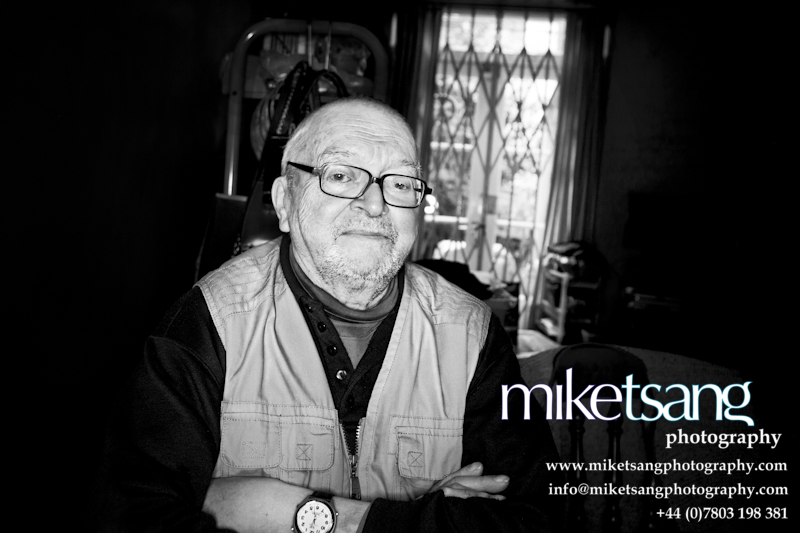
SA4QE is delighted to receive an email from photographer Mike Tsang offering an exclusive portrait of Russell Hoban, taken at the writer's home on his 86th birthday last month.
As our intrepid correspondent @AliB68reported, her delivery of The Kraken community's birthday gift was concluded a few minutes before the photographer was due to arrive to take the picture, for a feature called "Dreams of Literature" in the decidedly trendy magazine Glass. "Russell is featured there along with Junot Diaz, Liz Calder and Isabel Allende," comments Mike, adding that the photo attached is not the one used in the magazine itself. "Russell was great to photograph and it would be good to get this shot out there," he remarks.
SA4QE hasn't seen a copy of the actual magazine issue yet, but is far too excited to wait and get hold of one. There doesn't appear to be a version of the article on the Glass website, but here's a list of stockists worldwide if you'd like to head out and find yourself a real paper copy. (In fact if you see one, get yourself two, as you're bound to meet a fellow Hoban fan who wants one.)
On the evening of this special event, SA4QE fetches up in the main foyer of the British Library, which is a very civilised place – “Good evening,” says the security guy at the door, checking our bag, “how are you today?” Having assured him we are very well, SA4QE proceeds to the information desk for directions and is despatched back into the night across the forecourt to the Auditorium, where we are joined by Roland Clare and friend Louise Sheffield, and Jake Hoban, Russ’s son. After a brief chat we head inside, meet some other Hoban fans including Deena Omar, spot a guy wearing an Arga Warga t-shirt and mill about for a few moments before being ushered into the modern, woody hall decked with comfy seating.
Russ takes the stage with help from his wife Gundela, with Will Self taking a seat opposite. While Russ is short and stocky, Self is approximately 12 feet tall, yet hunched, giving the distinct impression of a rheumy-eyed vulture, or as AliB68 tweets, “a stork interviewing a robin”. Thankfully these metaphors are only visual, as the conversation goes on to be anything but predatory - as Martin Eve says, “Self [is] the most gracious of ‘interviewers’.”
The British Library host introduces Russ at some length with critical epithets including “the strangest writer in Britain”. Riddley Walker “keeps astounding everyone who encounters it ... its vision of a possible future English takes the story of a future English language as documented over in the BL’s exhibition Evolving English – One Language, Many Voices into a far, far, far possible future.” Self meanwhile was chosen for his “love of and bravery with language and his willingness to embrace the barely possible in his novels” which in turn made him an “ideal choice” to write the introduction to the 2002 edition of Riddley Walker.
Will Self thanks Russ and says it’s a great honour to share a stage with him, although “it probably bores him endlessly to have people say they grew up reading his books, yet I did grow up reading his books in those fine Picador paperback editions of the 1980s.” He says he can’t imagine anyone else writing the books that he did; “Russell doesn’t take the novel as a given. Some writers write novels like you might make a table – there’s nothing wrong with that, but they all have to have four legs and be level, whereas Russell approaches it as if there are no rules – the legs can all be of a different length, and you don’t necessarily have to eat off it – you might want to lie down under it.” He adds that he’s read RW four times and finds it “stunning and emotionally disturbing”.
Self then goes to the lectern and reads the Hart of the Wud passage from early in the book. Before he starts he says Russ had asked him backstage to be sure to do the readings “in the Kentish accent some two thousand years in the future.” The reading is superb: despite seeing Self many times on TV including in unlikely contexts such as Shooting Stars, SA4QE had never really considered him a performer, but he assumes a persona and reads the passage with magnificent menace (and a good accent). Above the applause afterwards Russ can be heard to tell Self the reading was “beautiful”.
Self asks whether the story of how the book came to Russ at Canterbury as told many times is true. Russ says it is true and that he will indeed be repeating himself to retell the story, but tells it anyway, citing a series of articles by Edmund Wilson about Punch and Judy puppeteers he had read in The New Yorker magazine coming to him at the same moment in 1974 that he first looked up at the vaulted ceiling of the cathedral.
Self says this genesis surprises people and asks whether, given the period in which the novel was written, there was no element of wanting to warn people of the follies of nuclear war in his planning of the book. “Writing novels with a message, I dare to say – although I’m sure there are examples to prove me wrong – is a sure road to disaster,” says Russ. “I think the best writing is done with what enters you and takes possession of you and doesn’t let go of you until you get the job done.”
Self says he understands the book started in normal English and the Riddleyspeak came later. Russ says it shifted into Riddleyspeak quite quickly and he kept lists of the words he’d invented to keep everything consistent. He also says he didn’t calculate it this way but realised that the language has the effect of slowing down the action to Riddley’s speed of perception. Self adds that the language seems simultaneously of the distant future and of the distant past; Russ agrees, saying some people had compared it to Middle English, but that this was due to inspiration rather than research. He summarises a half-remembered Ralph Waldo Emerson quote about “a channel of public energy that a man can tune into”, saying that he was able to tap into various channels of ideas during the writing that he hadn’t formerly known existed.
They talk about the book’s long gestation, Russ saying that after the first two years he had 500 pages which “weren’t it” because they weren’t concentrated enough and were spread over too much geography. Self asks how much moving to England inspired the book, and whether he could have written it in the US. Russ says he couldn’t have, then “tracks back” to the time period, recounting the familiar story of how he came to England as a fan of British ghost stories. “I opened myself to the ethos of... English storytelling? I don’t know, I’ve never said this before, I don’t know if it rings true or not, but anyhow that’s what I’m saying now ... I finished Turtle Diary in 1974 and around that time read a story by Gerald Kersh called Voices in the Dust of Annan, in which an explorer from the future falls through the ruins of what used to be London and finds himself living with some very small people who dress in rat-skins and hunt rats, and sing corrupted versions of songs like ‘Oo Kill Carobbin’, and I felt like fooling around with language that way.”
Russ goes on to relate his original discovery of the legend of St Eustace on the wall of Canterbury Cathedral, and Self talks about how Riddley’s people conflate the half-remembered and corrupted stories of Christianity with the “cultural memory” of science. Was there an intellectual element to this or was it inspiration? “I plead innocent to the charge of intellectuality,” says Russ, to laughter and a smattering of applause. “You have many supporters!” says Self.
Self talks about Riddley himself and says one of the surprising things about him is how many miles he covers during his “roading”, anything up to “50 miles a night”. “Charles Dickens was a hell of a walker, you know,” Russ shoots back. “He’d go for 25-mile walks and come home and write 50 letters. Riddley’s walking is consonant with his culture. As Goodparley says, ‘Riddley youre a mover.’”
Self wonders whether Russ’s army service in the last years of WW2 informed any of the grimness of the book. “I never fired a shot in anger, but I was shot at,” says Russ, “and I saw a lot of dead bodies turn various colours and bloating, so that comes into the consciousness.” Is Riddley’s world a war zone? “Yes it is, it’s full of danger from all sides.”
Self says that on one level he would have expected Riddley’s culture not to be literate, yet Riddley and other characters such as the officials at The Ram can read and write. At the same time, he says that it is one of the wonderful things about the book that it is an “entirely believable world entire” in which literacy can exist – it’s not as if Russ simply reproduced an iron-age culture. Did Russ research history prior to writing? “In the first drafts which were in standard English, Riddley was a kind of anthropologist studying his culture. That got tossed out fairly early on and I did what I had done in Kleinzeit, where instead of reading medical dictionaries I made up my own names for things.” Self says he remembers very well the language of Kleinzeit, and they talk tantalisingly briefly about this pre-Riddley book. (The two books aren't quite analagous though, as in Kleinzeit Russ uses real words such as stretto and hypotenuse in place of medical terms, whereas in Riddley the words are either entirely fabricated or corrupted versions of our own.)
Self says he found Riddley Walker very intense and emotional; was this Russ’s experience too? “Yes, I did live that book as I wrote it... the point where Riddley and I both wept when I was writing the book was after Goodparley and Granser have blown themselves up, and the Black Leader of the Bernt Arse Pack, who ‘looks like death on four legs’, shoves his nose into Riddley’s hand and wants to be petted, and Riddley says ‘That’s when I cried for the dead’ and that’s when I cried too.”
At the start of the book Riddley doesn’t allow himself to respond to his father’s death, but as the action progresses he changes allegiance to various men, such as Goodparley, Belnot Phist and Lissener. Is this about Riddley coming to terms with his father’s death? “The death of Brooder Walker has a profound effect on Riddley – he’s seething inside and is just about ready to go, when he digs up the Punch puppet and hauls Belnot Phist over the fence.” Self gets up to read this passage in his “absolutely immaculate” future Kentish accent:
Returning to his seat, Self invites Russ to open the “little bag” he has with him, and Russ opens his rucksack and brings out his Punch puppet, as made by Bob Wade. Russ summarises Punch’s notorious dark character and murderous acts: “Percy Press once said to me ‘Punch is so old he can’t die,’” and then, with a slip of the tongue into Riddleyspeak, “‘he’s a law unto hisself.’ ... There’s something in him that doesn’t care about him, that he is simply the vehicle for. And I always remember the ‘broken seagull’ – do you want to read that bit?” The two try to find the passage in question but can’t locate it; a Google search brings up the reference on the Riddley Walker Annotations website: “they myndit me of gulls eyes. Eyes so fearce they cudnt even be sorry for the naminal they wer in”. Russ summarises the passage and Self comments that it echoes what Lorna says early on in the book about “something looking out through our eye-hoals”: Riddley’s people have a sense of an elemental force that is refracted back to them through the Punch story. Russ: “Riddley looks back in time to us as the people who made the 1Big1 – this thing is in us, but it didn’t care for us.”
There then follows a very slapstick exchange. Self: “There’s a tension, isn’t there, in the perception of the people of the past – he both thinks that they’re kind of ‘before the fall’, they’re prelapsarian figures who are integrated psychically, and he feels the weight of dualism, doesn’t he – he’s always worried about the two being made into one, he feels his own reflected self-consciousness as a burden. And yet in the mythology, the Punch story that comes round, Mr Clevver is responsible for the destruction of all that’s good, so it’s almost as if enshrined in the people from the past is their own destruction at the same time.” Russ: “Yes. I’ve never had the opportunity to use the word prelapsarian.” (Much laughter.) “I myself feel postlapsarian but it eases up later in the day.” Self: “I never feel the day is done without feeling prelapsarian. [In fact] Let the day begin!” Russ: “Anyhow, my answer was yes.” (Even more laughter.)
They talk a little more about Punch and how old the myth is and the fact that there’s a Punch in every country including ancient Greece “where there were characters with large phalluses and did strange things”. Puppets “will always get a laugh and a gut response from the audience.”
What inspired Lissener and the Power Ring? Russ says the latter was inspired by the CERN particle accelerator, but there was no particular reason for having a blind Ardship of Cambry, except for his part in the story of the Other Voyce Owl of the Worl. Self “goes out on a limb” and wonders whether Russ’s having been trained as a radio operator during the war had anything to do with this “listening”: “No – I was trained as a radio operator, but that availed me nothing – I was a foot-messenger, and in fact I had such a bad sense of direction that I had to tear up bits of K-ration boxes to leave a trail so that I could find my way back... One time, I passed and re-passed a hill so many times that the Germans thought I was a troop movement.”
Self says it must have been very emotional finishing Riddley Walker, but as if that weren’t enough Russ then “goes and has another epiphany in Galilee” and writes Pilgermann. “How did it feel to move from Riddleyworld to Pilgermann-world, which is by no means that jolly?” “That was in my high-energy period,” says Russ, summarising the inception of Pilgermannduring a trip to Israel. “I like that book a lot... I had a good time writing it. I did a good Pope, Uncwit the Seventh or something, who had some pretty good dreams!” He laughs cryptically.
Self scoffs at this so-called high-energy period when Russ has been “remarkably prolific over the last decade”, turning out almost a book a year. Russ: “Well yes, I do what I can.” Self: “You continue to move into different areas – some of the work has been very erotic, for instance.” “Yes,” says Russ matter-of-factly, “well, I mean, life is, isn’t it?” Self agrees and Russ describes his next “big one”, Soonchild: “It’s about an eskimo shaman, whose daughter doesn’t want to be born because she refuses to come out into the world until he brings her the world-songs, so he brews up a big dream brew and goes on a dream trip through many changes. I have to hang on in there until 2012 as it won’t be published until then.” Self: “Well, I hope you’ll hang in there a little bit longer than that, if it’s all the same with you.”
Self then opens the conversation out to the audience.
The first questioner asks “Was it the case when you were writing Riddley Walker that you were in analysis and you would take along chapters to read aloud?”
Russ: “Would you repeat that for me, Will?”
Self: “He’s saying he’s heard you were in psychoanalysis and you would take the novel in MS to your analyst – which if true does beg the question of why your analyst didn’t pay you.” (Much laughter and applause.)
Russ: “It wasn’t psychoanalysis, it was psychotherapy, and I used to have sessions with Leon Redler, and I used to read him what I was writing. I’m trying to think of my reason – maybe I just wanted a private audience!” (laughter) “Maybe I wanted to test the validity of it, whether the characters would ring true.”
Self: “Do you remember any of what he said about the book?”
Russ: “No, I don’t.”
Self: “You definitely need your money back.”
Roland's friend Louise asks: “Did you have to tone the book down at all to make it more accessible?”
Self: “Were you calibrating it as you wrote it to see how difficult it was against standard English?”
Russ: “No, again I just wrote it as it came to me – ‘I done it how it come’.”
Self: “There’s a mini-glossary and notes in the new edition. I confess I found those very helpful... personally I find the book is very different each time I read it. I can’t help finding this is a function of the book that it reminds you that English is a very variable and flexible language.”
Russ: “I was very pleased with some of my inventions, such as ‘I had to vote no kynd of fents’, which is a breakdown of ‘vote of no confidence’.”
Self: “I think that Ed Miliband, the current Shadder Mincer, would be well advised to read Riddley Walker.”
Female questioner: “Do you have any academic experience of linguistics or pidgins and creoles?”
Self repeats.
Russ: “No.”
Self: “I knew he was going to say that.”
Russ: “There are things that spring naturally to the tongue, such as ‘great’ becoming ‘girt’. Also when I was growing up in Pennsylvania the auxiliary verb was often thrown over the side, so you’d say ‘I done this’ or ‘I gone there’.”
Self: “We do that here too.” (to questioner) “Is that called glottal drift or something?”
Woman: “I can’t remember.”
Self: “You studied it once though, didn’t you?” (laughter) “That was certainly worth our tax dollar.” (hilarity) “Sorry, that came out harsher than it should have.” [Roland Clare later advises SA4QE that the term Self was reaching for is 'metathesis': "I told him {Self} afterwards (he was v. nice!)."]
Self: “The bearded man up there – oh right, sorry, you’ve got a beard too, it’s not as big as his...”
Questioner with beard: “How much time did you spend in Kent researching the geography?”
Russ: “A lot of time. At that time we had a Bedford camper, and with my wife Gundel and our two sons we’d go up hill and down dale in the Wye Valley.”
Male questioner: “I have to read the book out loud rather than internally in order to understand it. I wondered whether reading it aloud to yourself was involved in the creation of it?”
Russ: “All of my books, not just Riddley Walker, are written for the ear, so that they will bear up under reading aloud. I sound them out in my head and go over them aloud until it works.”
Self: “Where does that come from? Were you read to a lot as a child?”
Russ: “Hm, I’m trying to remember... certainly I was read to a bit as a child, enough to instil it in me, and I was given plenty of books as a child, and I still remember my father - who was a socialist, but I guess he would have to be called a communist sympathiser at the time – used to bring me books – I remember one called Fairytales for Workers’ Children, a collection of hard-luck stories. There was a little black guy, and a yellow dog who had a terrible time. Left its mark on me, I can tell you.”
Self: “So presumably if your father was a fellow-traveller, you weren’t an observant family?”
Russ: “No, and apropos of his fellow-travelling, the first two rules of etiquette that I learnt were always to eat the label on the pumpernickel for good luck, and never to cross a picket-line.” (audience applause) “My father was put in jail for marching in a picket-line at the hosiery mill, which was the local industry in Lansdale.”
Self identifies the next questioner as “The woman in a hat just there.”
Woman in a hat: “Woman in a hat!”
Self: “Well, it’s an easy way of identifying you. I don’t know your secret hopes and desires.” (audience laughter)
Woman in a hat: “And you’re not going to, Will.”
Self: “Well if she objected to me typifying her as a woman in a hat, what can I do?”
Woman in a hat: “You didn’t start off by saying ‘Here is Russell Hoban in a hat’! Anyway, let’s stop arguing. Here is my question...”
Self: “What is your question?”
Woman in a hat: “Russell, in 1970, you gave a writing workshop at a conference on children’s literature in education in Exeter.” [She was probably referring to this.]
Russ: “Yes.”
WIAH: “At that writing workshop, which I wasn’t lucky enough to be born to be at...”
Russ (to Self): “What was that?”
Self: “SHE WASN’T BORN. Or else she would’ve been there.”
(audience hysteria)
Russ: “All right! You’ve made the effort now...”
WIAH: “...you said the most important thing was to describe ‘the thingness of things’. Do you still believe that?”
Russ: “Was describing..?”
Self: “‘The thingness of things’ – what guys with ten-dollar words call quiddity, I believe.”
Russ: (pondering) “The thingness of things... um, yeah, the thing-in-itself...” (ponders some more) “Ding an sich?”
Self: “Ding an sich... I knew you’d get onto Kant and metaphysics, hiding your intellectuality.”
Russ: “I have never read, er, ‘Karnt’.”
Self: “I believe it’s pronounced Kunt actually.”
(audience beside themselves)
Russ: “I’m getting credit for learning I don’t have. I can take a book this thick and riffle through it and come up with one quotation which will convince people I’ve read the whole thing. It’s artful.”
Self: “Maybe what the woman who we must not call the Woman in a Hat is saying is that your novels are about ‘things’ rather than, say, character or the relationships between people.”
Russ: “The writer whom I credit with the Thingness of Things more than anyone is Anton Chekhov, who is my current main squeeze. He just does it, he can talk about the moonlight on the ocean, the smell of the trees and flowers in a garden which transcends mere description – he gets right to the thingness of things. It can’t be learnt. You’ve either got it or you haven’t. If you’ve got it, flaunt it.”
Male questioner: “Riddley Walker is depressing and disturbing and the end is ambiguous. Do you find it optimistic or pessimistic? How do you classify it in terms of a story?”
Russ summarises to Self what he thinks the question was.
Self: “You got it in a nutshell, although the front end was largely a statement. A good statement, mind you...”
Russ: “It’s left that way – we don’t know what’s going to happen. We don’t know what his future is, any more than we know our own.”
Self: “A final question from the man with the beard, glasses, shirt, pullover, trousers and underwear.”
Male questioner: “Hi Will.”
Self: “Hi.”
Male questioner with clothes: “When you were first looking at the painting of St Eustace, it was a life-changing moment, but I was wondering how long you were looking at it for and how you were feeling.”
Russ: “The...?”
Self: “He wants a more visceral description of your epiphany.”
Russ: “The viscera of my epiphany are internal.”
Self: “Well, how about the thingness of your epiphany?”
Russ: “I don’t rightly know that I can say more about it. It just got to me. You don’t have to be a writer to have that experience when an event or something you see or some person suddenly gets to you, and there it is, you suddenly have to do something about it. Can’t say more than that.”
Self: “Well, I don’t know about the rest of you, but I think the modern mania for getting writers up on stages and making us trot around like performing dogs, like the dogs in Riddley Walker, when he has the vision at Cambry and they rise up on their hind legs and dance around him, is often not a good thing, but I’m sure you’ll agree that this evening has been an exceptional and rare privilege to hear Russell talking.” (Sustained applause)
Russ: “Can I say that I could not have asked for or imagined a better companion and conversationalist than this gentleman.” (more applause)
Most of Russell Hoban's novels are love stories of city-dwellers. Is that too sweeping a statement? In an email to Head of Orpheus webmaster Dave Awl back in 2002, he described his then-impending novel The Bat Tattoo as "my usual thing of two people meeting in an odd way in London and a quietly offbeat relationship developing." Readers of his early novel Turtle Diarywould recognise this theme and structure; indeed that and The Bat Tattoo share the form of the male and female protagonists taking turns to narrate the story. The outcomes are different however; in Turtle Diary Naeara and William bond over a plan to set sea-turtles free from London Zoo, but whether they are actually suited to each other romantically remains to be seen. In The Bat Tattoothough, there seems no doubt that Roswell and Sarah are falling in love.
Kleinzeit, published the year before Turtle Diary, is a manic linguistic romp in which the eponymous hero no sooner gets admitted to hospital than he falls in love with the ward sister. Hoban's most recent novel, Angelica Lost and Found, sees the lovesick hypogriff from Girolamo da Carpi's painting Ruggiero Saving Angelica break free to search for Angelica in modern-day San Francisco. In between, Herman Orff in The Medusa Frequencylaments a lost lover through the eternal story of loss, Orpheus and Eurydice, while in Angelica's Grottoa septuagenarian art historian seeks love of a darker sort through a pornographic website. Maybe the only novels not principally "love stories" areThe Lion of Boaz-Jachin and Jachin-Boazand Riddley Walker, both of which, while seeing the protagonists involved with other characters in a sexual or romantic way, are principally quests for something more complex. It isn't, perhaps, therefore an overstatement to say that Hoban's abiding theme is love and relationships, even if he tackles the subject in a satisfyingly different way from most writers.
Over the years SA4QE has seen hundreds of quotes chosen from Russell Hoban books. Here is a selection of quotes that may be appropriate for today:
"We smiled at each other over our glasses, time seemed full and easy, available in unlimited amounts. George seemed to carry a clear space about him that made all things plain and simple where he was."
It is not love that moves the world from night to morning, it is not love that makes the new day dawn. It is the longing for what cannot be. The world needs the power of your yearning, the world needs the power of your love that cannot be fulfilled.
"He loved her simply because she was. What a thing, thought Jachin-Boaz. Love without purpose."
- fromThe Lion of Boaz-Jachin and Jachin-Boaz
(chosen by Emmae Gibson)
Emmae comments: "A Hoban novel for a Valentine's Day gift would probably have to be Amaryllis Night And Day. Not only is it love and romance, sensitive and complex, hobanesque fantasy-reality with soft colours and crazy glass, but also, (more important, you might say, on such a day,) it has a happy ending."
What are your favourite Russell Hoban quotes on love? Would you give a Hoban novel as a Valentine's Day gift? Please comment below.
There were some 125 people in attendance at the Guardian's Scott Room, where Hoban spoke to Mullan and answered questions from the audience for about 90 minutes on Riddley Walker.
Dressed in a black roll-neck and beige bodywarmer, Hoban took to the stage with help from his wife Gundula to warm applause. He doffed his black baseball cap and as Mullan did his introductions Hoban rummaged in a bag for a Mr Punch puppet, extemporising a few Punchisms in authentic voice to everyone's delight.
SA4QE didn't get a recording or formal notes of the interview (unlike for the somewhat shorter Serpentine gig last month), and it was being recorded for a future Guardian podcast anyway, but fortunately several of Hoban's beautifully-crafted answers were almost exact quotes from an article he wrote for the Guardian Book Club (to be published in the print edition on Saturday 27 November). 'People say to me: "Where do you get your ideas?" "Out of the air,"' was among Hoban's replies, as was his reference to 'the place where the remembered blood of Thomas Becket seethes on the stones' during an account of first visiting Canterbury Cathedral and seeing The Legend of St Eustace.
SA4QE, not being a Riddley expert (we leave that to the formidable Eli Bishop and his RW Annotations website), admits it was unaware of the fact that St Eustace 'has no official standing among the beatified. Perhaps his legend turned up on the back of some Middle-Ages cornflakes box and grew from there. Being thus non-factual, Eustace is quite at home in a work of fiction.' Hoban talked awhile about the poor St Eustace, recounting his separation from his children before finally landing up roasted alive in a brazen bull, checking at one point with Mullan if he was 'spending too much time on this'. Mullan, as captivated as the rest of us, bade him carry on as long as he wished.
Mullan read out some of the place names Hoban gave to actual Kent locations in Riddley Walker (Do It Over for Dover, Horny Boy for Herne Bay etc), querying where 'Bollock Stoans' was. 'I don't remember that one,' Hoban replied, adding something to the effect that 'a certain amount of bollocks' was involved. Another Mullan question revolved around the character Abel Goodparley's misinterpretation of the story of St Eustace, asking Hoban to read out the passage in question. Hoban explained that his eyes don't allow him to read very well these days, so Mullan read it out instead ('St stands for 'sent', meaning he dint jus turn up, he was sent' was among the well-received quotes from the book).
A question about how Mr Punch came into things produced one of several excellent lines of the night, Hoban asserting that his ability to write what and how he writes lies in a facility for 'being friends with my head ... I take its hobo journeys in fast freights, riding the blinds to unknown destinations. Sometimes I get thrown off the train in the middle of nowhere and sometimes I get to the Big Rock Candy Mountain.' One of these journeys evidently took in Punch and Judy, and thankfully Hoban was good enough friends with his own head (what a delightfully Orphic image!) to take that ride and connect Punch with St Eustace to produce the unique work we know today.
There followed a further 40 minutes' fascinating patter, during which Hoban gave some eloquent - if sometimes unnervingly brief - answers, touching on the language of Riddley Walker - 'it slows the reader down to Riddley's pace of thought and the language itself becomes a character in the novel' - and on why people feel drawn to the book despite its apocalyptic mood. Hoban's paraphrased answer to the latter revolved around the perennial attraction to ghost and horror stories as well as to the idea of characters at the very extremes of existence. 'I believe Cormac McCarthy has done something similar recently with a book called The Road,' Hoban added - to, frankly, the relief of SA4QE which understood from past exchanges that the great man studiously avoided contemporary fiction.
John Mullan
Mullan then threw the evening open to the audience. Again, the exact answers (and indeed the exact questions, some of which were of baffling length) will become clear when the podcast is released, but thankfully Claire Armitstead, the Guardian's literary editor, was tweeting summaries of each exchange in real time. The following are summarised from her selected tweets.
'I've been asking myself what is it with the dogs [said Hoban about the book's famous canines]. It's first off, the blackness of them. [I'm addicted to black.] I'm a schwartzophile. I based the dogs on the physiognomy of the hyena. They're not tail-waggy things.'
'Punch is the lawless id, the spirit of rebellion that Riddley digs up. It's the dead hand.'
Q: 'What's your philosophical position?' A: 'All my books are an exploration. The action comes out of the characters and the characters come out of the action.'
One questioner asked at some length how Hoban reconciled writing his Frances series ('my one commercial success') and other books for children with the dark adult fantasy of Riddley Walker. Hoban's explanation gave rise to what will probably be Hoban's best-remembered line of the night: 'I believe it's called talent.' If almost any other writer had said this they would have been roasted in a brazen bull for it, but it seemed more matter-of-fact than arrogant and even a non-Hoban fan could hardly argue with it - SA4QE is of course biased, but the body of work speaks for itself.
Russell Hoban signs for Roland and his class
Another questioner had read the book after doing Islamic studies and said that when people ask what Sufism is she tells them 'read Riddley Walker'. Hoban responded that he hadn't read Sufism. He added though that he had read zen.
There were a number of other questions which will have to wait for the podcast, but the final one was sent in by Kate Laity on Twitter - 'Is it possible to have such a varied career as yours today?' Hoban responded, refreshingly without cynicism: 'Talent will always find a way.'
Several of SA4QE's friends were also in attendance, including Tim Haillay, Deena Omar (forever known as the 'Some-Poasyum quiz winner'), Alastair Bickley, Richard Cooper and Bristol Grammar School's Roland Clare, who had brought eight upper-sixth English students with him. Roland's former students Rowan Evans, who pinned a Riddley quote to a tree on a former 4qation, and Thomas Lipscomb also came with the party on a fabulous day trip which had taken in Riddley-themed sessions at the British Library. SA4QE is pleased to report that the Bristolians were interviewed later as part of the Guardian podcast about their studies of the book - this can be heard about 21 minutes into the audio file on this page.
Altogether it was a fantastic evening, and SA4QE thanks the excellent folks at The Guardian, including of course John Mullan as well as Claire Armitstead, Hannah Freeman and Justine Jordan for enthusiastically tweeting about it.
Last weekend Russell Hoban made a rare public appearance - an onstage interview for Map Marathon: Maps for the 21st Century, a multimedia event featuring dozens of writers, artists and academics hosted by the Serpentine Gallery at the Royal Geographical Society, London. During the interview Russell talked about the "mystique" of maps and the part they have played in his work, and his new novel Angelica Lost and Found. The SA4QE event and The Kraken Hoban community also got a mention. A number of SA4QE/Kraken stalwarts were in attendance including Anthony Davis, who takes us back there now. A transcript of the interview is included below.
Travel difficulties / delays apart, and despite being without a MAP at the crucial moment requiring a circumnavigation of the Royal Albert Hall, all turned to the good! Peering into the dark of the RGS's lecture theatre soon revealed the features of some well-known Krakenites, and I even had a seat reserved where I could witness Gilbert and George, rather tangentially, reading their 'mapping' of postcards that, to their eye, featured the Union Flag (they know so much better than to call it the Union Jack!), i.e. a list, in alphabetical order, of the largely arbitrary - and not without a comic bent - titles that they had given to these cards whose collection they had so dutifully curated; likewise their mapping of 'telephone [box] cards', but only those that - to their mind - left something to the imagination.
For me, seeing these icons of the gay art world and hearing them talk about their maps of county towns and seaside resorts was a very fitting prelude to Russ's own session, and one which made the whole protracted jurney (sure some Riddley?) quite worthwhile, as, of course, did seeing Russ again and a no. of Hobanites, old and new.
Eleanor Bron started the session with a lovely reading from the start of The Lion of Boaz-Jachin and Jachin-Boaz, although I really don't know how she kept her composure with the noise and bustle of people re-taking their seats, and generally milling around the lecture-space as if no thought-out and sensitive rendition were being given. [The reading is available from Thoughtcat as a 3mb mp4 audio file; you will need to turn up the volume as it is quite soft.] Russ was then helped, with the support of a clearly much-needed arm (that of his would-be interviewer and host, Hans Ulrich Obrist), down, across and up to and into one of the padded chairs to the right of the lectern: his physical frailty was patent, and I'm sure that everyone watching (not just those who knew him) must have felt for the effort that he was making just to be present at this event.
Hans Ulrich Obrist (l) with Russell Hoban
So much was Russ enjoying being there, though, that it was evident not only in his mental liveliness, but also in his quirkily engaging quality and character of speech, which were immediately to the fore in his first answer. Coupled with these was the comfortable way in which he was clearly sensing the room and its occupants, as the professional communicator that he is. (In fact, he could be seen, once settled into his chair, already putting out what one could call tentacles or feelers for this purpose.)
After first answering a question about Lion that arose from the reading, Russ had politely, but definitely, to decline to address the second one put to him [of whether he thought that the "master map" that Jachin-Boaz wanted to make for his son to "show him where to find whatever he might wish to look for" was a kind of precursor to the Internet; "Can I dodge that question?" Hoban responded, to the delight of much of the audience]. I felt this exchange spoke volumes about the lack of preparation on the part of the interviewer, in establishing a rapport with Russ: I am guessing that, otherwise, he would not have offered a lead that was felt to be so inappropriate that Russ seemed quickly to have decided that he would prefer to answer a different question and volunteer some information.
I'm not definite about this, because I obviously imagined that the question asked was going to be turned to, and Russ then talked about something else, but I think that what he had been presented with was a too circumscribed way of inviting him to share feelings about his works and their genesis: I believed at the time, and still do, that overstepping a question to present material that one would have one's audience hear, rather than just the response to some tired or otherwise vexing or uninteresting enquiry, must have been the right one. (I know from talking to Russ that he, rightly, does not reward poor questions with his attention, and I think that it is because he simply doesn't find any life in them, and so the questioner is punished, in a way, with an impoverished answer.)
I had been glad to learn, from his answer to a question about Riddley [see below], that he had used maps in writing it, both an early Ordnance Survey map of Kent, and one, of a futuristic nature, that projected that a former channel of water would reopen, separating the rest of the county from an area that he called The Ram. For me, this fuels an existing desire to be guided around the lands over which Riddley roams (and from which others have come), and to do so in, on and around a vehicle with a like-minded crew, willing to absorb the sights, sounds, drinks and other delicacies in a joint exploration of what this very different county tells us about the places in which Russ placed the unfolding of his story.
The interview
The following is a transcription of the interview from an audio recording by Richard Cooper. The recording started in the middle of the answer Russell Hoban was giving to the above "dodged" question about maps and the Internet.
RH: ... As a boy I used to send away to the Canadian-Pacific Railways for their maps and they sent me these wonderful maps with the provinces and the states in different colours and blue for the oceans, and maps are a - how can I say... er, take Robert Louis Stevenson's book Treasure Island - every edition, whether hardback or paperback, has that map in the front, and you look at that map and you know good things are in store for you. [laughter] And that is more often that not connected to action - you look at a map because you want to get somewhere to do something. Sometimes it's just you look at a map to know where you are. And when you first approached me about this stuff I began to think about maps and it hit me all of a sudden that maps were the precursor of language. And I was thinking - we don't know whether prehistoric man, Cro-Magnon man, had language or not, but I was imagining a couple of Cro-Magnon guys, and one of them wants to tell the other where he saw a herd of mammoth. And first of all he would have to establish the man he was talking to himself, so maybe he marked something in the dirt with a stick, make a stick figure or maybe just some kind of a mark, and then he would have to indicate time somehow - it was time behind him, it was yesterday, he saw the herd of mammoth by a river and there was a big rock. And so then he would scratch in the dirt the river and something that indicated the passage of time, say the sun going up and down, and that would be the first map. And from that map he had language. And now you get into a taxi and the driver has a satnav, and [inaudible] maps of the heavens, so it all began with a guy drawing with a stick in the dirt.
HUO: What about your own maps? Do you have a collection? Gilbert and George talked about the huge collection they have of maps, do you collect maps?
RH: I have often used maps. When I wrote Riddley Walker I had a copy of the first ordnance map, I think it was the very first one which was during the Victorian period, and I also had a put-together composite of the ordnance survey maps for the area that I was working in, and I had this up on the wall, it's a big thing, and I also had a chart of the Thames Estuary, which indicated places that I needed to refer to. And I have smaller maps that showed parts of Kent that I was working in. And the maps are always a strong support and a kind of inspiration - as I say there is a mystique about maps that I have responded to all my life, and working on those maps, with those maps, I got Riddley Walker done, and I also drew a map of my own which I put together with the help of - I forget the organisation they were with, it might have been an agricultural college, I don't know - who showed me how in the future the Wansum Channel between one part of Kent and the other would probably open again, so there would be water flowing between the main body of Kent and the other part, which in my book is called The Ram.
HUO: Are there other books of yours with maps?
RH: Well, The Mouse and His Child has a little map in it, and The Trokeville Way has a map in the front. Oh and I'm also thinking apropos of Stevenson's map in Treasure Island, in Edgar Allen Poe's story The Gold Bug I believe there was a map too. And maps are frequently used in thrillers, you know, where the bad guys are after the map that the good guy has, and there are... I think that as a boy we may have sometimes played chase games in which one person had a map.
HUO: I am curious to know about your latest novel, Angelica Lost and Found. Any connection to maps there? If not, I am curious to know anyhow, it would be great to hear about your new book.
RH: Well [laughs], it's a funny thing, when I wrote the book, it didn't seem out of the ordinary to me. It happened to be about a hippogriff who falls in love with a flesh-and-blood woman. The hippogriff is an imaginary animal, and this imaginary animal falls in love with the flesh-and-blood woman, and they achieve intimacy [laughter], and one thing leads to another all through the book, and the imaginary animal has a voice in the narration. And as I say, when I wrote it [there was] nothing remarkable about it, and then I'm trying to figure out where it was coming from. And in 1997 having read Barbara Reynolds's wonderful, wonderful translation of Orlando Furioso I wanted to do something with the characters and the ideas that were in it. And I tried to do something with the hippogriff, whom I called Volatore, and it went on for two pages and fizzled out, and I couldn't see what to do with it. And then a couple of years ago I took out a folder I had called Ariosto Revudebus[?] - I looked at my notes and there was nothing there, and I began to think of another way of doing it, so that's when I started writing Angelica Lost and Found, and that impetus carried me along to the end of it. I might say that the main stimulus that got me started on it was a painting which is reproduced on the cover of the Italian edition of Orlando Furioso, and the painting is by Girolamo da Carpi, a 16th-century Italian painter, and it shows Ruggiero mounted on a hippogriff rescuing Angelica from the sea-monster called Orca. And this painting is interesting because - it's on the cover of the book Angelica Lost and Found - the painting is interesting because first of all it differs from previous paintings by da Carpi, like his Madonna and Child: this painting is almost naive in its rawness, and oddly Angelica is squeezed into a corner held behind a rock, and you can't even see her whole body, you can't see her too clearly, and over here in the sky is this hippogriff with Ruggiero sitting on it and raising his sword. And that painting stayed in my mind. And that was how I got started thinking about what to do with these characters, Ruggiero, Angelica and the hippogriff, and that's the novel.
HUO: I have one more question and that is, I hear a rumour that every year on your birthday, your many fans, also known as the Kraken Club, leave quotes from your work on yellow paper in many places they hope will be picked up. I read also that one member left 33 quotes in 29 locations all across London, which is almost connected to mapping. Can you tell us about this fan club?
RH: Well I don't remember how The Kraken came into being [we do! - Ed], but it did and as you say they ... select quotes from my books and they type them on yellow paper. I use yellow A4 - people ask me why it's yellow A4, and it's because when I was in America I would read many books that would say "The man had a plain deal table on which was a ream of ordinary foolscap". I thought what was foolscap? Maybe it's a kind of paper they make fools' caps[?] out of*. When I got to London I found out foolscap was a size, but I still thought of it as being yellow paper, and that is why I write on A4 yellow paper.
HUO: Thank you so much Russell, thank you very much. [applause]
* Richard notes: This bit of the audio was difficult to hear and the connection with foolscap and yellow doesn't really make sense; there is more information on the SA4QE FAQ page about Russell Hoban's choice of paper. Coincidentally though a Google search I did to try and shed light on this turned up this curious Fool’s Cap Map of the World.
Following Russ's appearance, the attendant Hoban fans filed out of the auditorium in an effort to say hello to their man. Anthony takes up the narrative again.
Anthony provides light for Russ to sign
One of the photographers for the event had asked Russ if he could walk 100 metres to where a studio had been set up, and he had had to decline to take those steps (pun intended). Instead, then, some shots were then taken of him in front of a temporary - and easily overlooked, by those such as I - barrier between the public areas and the stage door [see the result on the Serpentine's Facebook page], so, at this point, Gundula [Russell's wife] said that Russ was in need of a glass of something. When she said that the whiksy (hic / sic!) that I happened to have about my person would be too much, investigating the environs allowed me to rustle up (pun intended!) a glass of Merlot. It was then decided that occupying a free table in the bar was the best way around giving 'hospitality space' to Russ, which had not otherwise been forthcoming, and also to his guests.
Gundula and he had been so kind, and had bought wine for everyone (two bottles each of red and white from the bar - I should rephrase that: they weren't buying two bottles of wine for each person, but four bottles to serve us all!).
Russ and I had a chance to talk about a few things [and he also chatted to the other Hoban fans present and signed books they'd brought]. Maybe / maybe not (in a flicker sort of way) you weren't there yourself - but had you thought that you might have been there on a map that Russ might compile of all of us here to keep us close and near, which he might have in his breast-pocket, or even in his heart...?
The Slickman A4 Quotation Event (SA4QE) was an annual literary activity in which fans of the novelist Russell Hoban celebrated his birthday on 4 February by placing favourite quotations from his books in public places.
Enjoy the huge archive of quotations, reports and photos on this site dating from 2002 when the event started, up to and including 2012.
New Russell Hoban website launched!
Updated 21/10/12: A new website devoted to Russell Hoban was launched last month. Containing a biography, information pages on the books and scores of essential links, russellhoban.org is the definitive guide to all things Hobanesque.
New Russell Hoban books out now!
On 1 March 2012 Walker Books published Russell Hoban's final young-adult book Soonchild, with amazing illustrations by Alexis Deacon. Read a lovely review in the Guardian, see some exclusive spreads from inside the book and get more details and a text extract at the Head of Orpheus website. Walker tweeted photos of Russ and Alexis at their offices in January 2011.
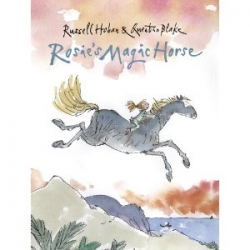
Also, on 4 October 2012 Walker published a beautiful new children's book. Rosie's Magic Horse is illustrated by the legendary Quentin Blake (with whom Russ had formerly collaborated on Trouble on Thunder Mountain, among other titles) and tells the story of a little girl and her collection of ice-lolly sticks, which dream of being a horse.
SA4QE 2012 - Celebrating 10 years of SA4QE
On 4 February 2012 the Slickman A4 Quotation Event celebrated 10 years of sharing Russell Hoban quotes, with many fans across the world posting their favourites in public places both real and virtual. This site was updated daily between 4 February and 10 March 2012 with these quotes. See all 2012 quotes
Our dear friend Russell Hoban passed away on 13 December 2011. He was 86. There are more details in this blog post. You can also sign our book of condolence.
Russell Hoban's last novel Angelica Lost and Found was published in November 2010 and is available from Amazon and all good bookshops. There were good reviews of the book in the Guardian and Independent and an excellent interview with Russell Hoban in the Scotsman, as well as a revealing audio interview at Tim Haigh Reads Books.
In October 2012 another new children's book, Rosie's Magic Horse, with illustrations by the great Quentin Blake, was published by Walker Books, who tweeted a photo of the two together in July 2011.
Between late 2010 and early 2011 Russell Hoban took part in an almost unprecedented number of media activities to promote his new book Angelica Lost and Found and the 30th anniversary of his most famous novel, Riddley Walker. SA4QE blogged about all of these events and this site contains some exclusive content from them:
On 15 February 2011 Russ took part in a brilliant conversation with Will Self at the British Library about Riddley Walker; SA4QE has a full multimedia report including a transcript, photos and a video of Self reading a classic passage from the book.
Between 29 September and 16 October 2011 the Trouble Puppet Theatre Company in Austin, Texas staged a version of Riddley Walker. Russell Hoban was supportive of the production. Details can be found on the Trouble Puppet site. There is currently talk of the show touring to other venues in the US.
Russell Hoban reader survey results are in!
Ever wanted to know Russell Hoban fans' favourite books, characters or quotes? Now you can, with the results of our recent survey.
Save Gaby's Deli
The London restaurant Gaby's Deli, which is mentioned in Russell Hoban's books The Bat Tattoo and Linger Awhile, is under threat. The landlords want to close it and, reportedly, replace it with a chain restaurant. Give their Facebook page a like or sign their petition.
Still available - the 2005 Russell Hoban Convention booklet
In 2005 the first international convention for Russell Hoban fans took place in London, and was marked by the publication of a fantastic 48-page booklet featuring exclusive contributions from innumerable fans and associates including novelist David Mitchell and actress Glenda Jackson. A wonderful memento of the event, it's also a beautiful collector's item and must-have for any Hoban fan. Although in limited supply, copies of the booklet are still available at £6.00 each plus p&p. Order direct from the Russell Hoban Some-Poasyum website.
SA4QE 2011
Russell Hoban turned 86 on 4 February 2011 and fans celebrated in traditional style by leaving quotes from his books in public places. Browse their quotes here. The Russell Hoban community group The Kraken sent Russ a birthday gift of The Kraken Rum. Read a report about this at the Fantastic Reads blog.
Riddley Walker SA4QE special
To celebrate 30 years in print of Russell Hoban's most famous novel Riddley Walker, SA4QE broke with its February tradition and conducted an extraordinary SA4QE on 5 November 2010 in which participants shared their favourite quotes from the book. This site was updated throughout November 2010 with the quotes submitted.
Feel like searching?
To search this blog simply type your query into the search box at the far upper left of the page (the one prefixed with the stylised Blogger "B").




 , and they talk tantalisingly briefly about this pre-Riddley book. (The two books aren't quite analagous though, as in Kleinzeit Russ uses real words such as stretto and hypotenuse in place of medical terms, whereas in Riddley the words are either entirely fabricated or corrupted versions of our own.)
 . “How did it feel to move from Riddleyworld to Pilgermann-world, which is by no means that jolly?” “That was in my high-energy period,” says Russ, summarising the inception of
 , for instance.” “Yes,” says Russ matter-of-factly, “well, I mean, life is, isn’t it?” Self agrees and Russ describes his next “big one”,


 as "my usual thing of two people meeting in an odd way in London and a quietly offbeat relationship developing." Readers of his early novel
  would recognise this theme and structure; indeed that and The Bat Tattoo share the form of the male and female protagonists taking turns to narrate the story. The outcomes are different however; in Turtle Diary Naeara and William bond over a plan to set sea-turtles free from London Zoo, but whether they are actually suited to each other romantically remains to be seen. In The Bat Tattoo
 , sees the lovesick hypogriff from Girolamo da Carpi's painting Ruggiero Saving Angelica break free to search for Angelica in modern-day San Francisco. In between, Herman Orff in
  laments a lost lover through the eternal story of loss, Orpheus and Eurydice, while in
  a septuagenarian art historian seeks love of a darker sort through a pornographic website. Maybe the only novels not principally "love stories" are
  and
and  , both of which, while seeing the protagonists involved with other characters in a sexual or romantic way, are principally quests for something more complex. It isn't, perhaps, therefore an overstatement to say that Hoban's abiding theme is love and relationships, even if he tackles the subject in a satisfyingly different way from most writers.
  . Not only is it love and romance, sensitive and complex, hobanesque fantasy-reality with soft colours and crazy glass, but also, (more important, you might say, on such a day,) it has a happy ending."


 On 4 February 2012 the Slickman A4 Quotation Event celebrated


 In 2005 the first international convention for Russell Hoban fans took place in London, and was marked by the publication of a fantastic 48-page booklet featuring exclusive contributions from innumerable fans and associates including novelist David Mitchell and actress Glenda Jackson. A wonderful memento of the event, it's also a beautiful collector's item and must-have for any Hoban fan. Although in limited supply, copies of the booklet are still available at £6.00 each plus p&p. Order direct from
  Russell Hoban turned 86 on 4 February 2011 and fans celebrated in traditional style by leaving quotes from his books in public places. Browse their quotes
  To celebrate 30 years in print of Russell Hoban's most famous novel


 Posts
Posts


