Showing posts with label peter morrison. Show all posts

Tuesday, 28 February 2012

peter morrison 2012

somewhere along the line, between there and here i think i flickered once or twice too many times. it seems the only logical explanation, the experienced gaps in time that account for the last week, or two...

i had visitors, so found my distracted, unsure what my plans were for the day of fourqating. which left them with a flickering, unsubstantial/unsubstantiated kind of spontaneity.

on my recent re-read of fremder, i had noted page numbers in my phone. so minutes before going out the door for the evening, i grabbed phone, yellow paper, and a fremder. and with those three objects i scrawled out, in huge hurried letters, the following two quotes from that novel:

What I like about Badru is that its so much what it is, so much the appearance of itself printed on the very thin membrane that we call reality. On the other side of that membrane is the endless becoming that swallows up years and worlds, Badr al-Budur, Mikhail’s Intergalaktik, even the dream rats and their sacred objects, in the darkness of no remembrance.

...

Being is not a steady state but an occulting one: we are all of us a succession of stillness blurring into motion on the wheel of action, and it is in those spaces of black between the pictures that we find the mystery in which we are never allowed to rest. The flickering of a film interrupts the intolerable continuity of apparent world; subliminally it gives us those in-between spaces of black that we crave. The eye is hungry for this; eagerly it collaborates with the unwinding strip of celluloid that shows it twenty-four stillness per second, making real by an act of retinal attention the here-and-gone, the continual disappearing in which the lover’s kiss, the shots are fired the horses gallop; but bellow the threshold of conscious thought the eye sees and the mind savours the flickering of the black.

- from Fremder

my brother and i nipped into a book shop, late on in the day, before moving on to the next steps of our insubstantial plan. there i found of books that were on "sale", one piece of yellow paper was thrust into the pages of iain banks' The Steep Approach To Garbadale - which seemed appropriate given he is a scottish writer and these events took place in scotland. (think quick with this logic thing...) the second piece of paper was thrust equally hastily, and sneakily into a copy of ben aaronvitch's Rivers of London. this too seemed appropriate, a curious london novel, for a writer who wrote so much about london. the banks is one of his rare ones i have not actually read, however i would recommend aaronvitch's novel, an enjoyable read.

anyway, that was my belated qatation.
yours flickeringly.
peter

Monday, 28 February 2011

peter morrison 2011


Today is Russell Hoban's 86th birthday, to celebrate, have a quote from the first novel of his that I ever read:
Empty Spaces

‘A sense of loss pervades the paintings of Peter Diggs,’ wrote the critic Cecil Berkeley about my last show at the Fanshawe Gallery. ‘His palette is muted his compositions unsettling. The figures in his pictures seem about to depart, and there are odd empty spaces that make the viewer wonder who or what is coming.’

But that’s life, isn’t it? And those of us who think about the empty spaces tend to paint pictures, write books or compose music. There are many talented people who never will become painters, writers, or composers; the talent is in them but not the empty spaces where art happens.

- from Amaryllis Night and Day
Posted to Tumblr and LiveJournal

I think this quote is particularly significant [on my Tumblr art blog] - about the empty spaces that drive creativity.
The dream stayed with me so strongly that I could play it back like a videotape: the bus stop in the summer dusk, the street lamps lit against a sky still light - that time of day that always catches at my heart.

There was the sign that said BALSAMIC; the letters were sharp and clear; they riffled like rail departures but the name stayed the same. There were those shaky-looking buildings and the bust stop and there she waited, the thin woman with the straw-coloured hair, blue eyes, and pale face, unknown but seeming to look at me round the edges of my memory. Sleeping or waking, I’d never seen her before.

Again and again she gestured with her clenched fist and said “Yes!” silently. She wanted me to follow her. Why? Here came the bus: FINSEY-OBAY, yellow, pink and orange rice paper and bamboo lit from within - like a Japanese lantern. Such a light against that not-yet-dark sky! Again she looked at me as she boarded the bus and I felt the thrill of terror as stepped back. And again the sense of loss. What did she want? How could I find her again?

She was gone; I was left behind in the present moment, which not a simple finite thing measured by the clock; it’s a palimpsest of all the present moments before it, their images, music, words and whispers rising up through the layered years from the oldest present moment to the newest; and in those moments live, remembered or forgotten, sleeps and wakings and dreams.
- from Amaryllis Night and Day
Posted to Tumblr

While this is from the third chapter, it recaps the dream that occurs in the first chapter, it is this image which caught my attention, this image being the reason I bought this book in the first place. I’d love to see that image come to life, the bamboo bus in its yellow, pink and orange rice paper.

Saturday, 26 February 2011

Twitterers, Facebookers and Bloggers 2011

After all, when you come right down to it, how many people speak the same language even when they speak the same language?
- from Turtle Diary, tweeted by Joe Snow

Place of dismemberment? said Kleinzeit.
Everywhere, all the time, said Hall of Records.
- from Kleinzeit, tweeted by David Dixon

Sometimes now I dream of music. Not opera music, what it is I don't know. Over me, under me, all around me. I can hear it, I can feel it. when I wake up it is gone. Lost, nothing remembered.
- from Come Dance With Me, tweeted by John D here and here

‘A sense of loss pervades the paintings of Peter Diggs,’ wrote the critic Cecil Berkeley about my last show at the Fanshawe Gallery.
- from Amaryllis Night and Day, tweeted by remotevoices

There's nothing beyond the last visible dog but us.
- from The Mouse and His Child, tweeted by Chris Bell


(Bat bowl from the Victoria & Albert Museum that inspired The Bat Tattoo)

A Dog shall rise and a Rat shall fall.
- from The Mouse and His Child, Facebooked by Alison Baker

I do not like the way you slide,
I do not like your soft inside,
I do not like you lots of ways,
And I could do for many days
Without eggs.
- from Egg Thoughts and Other Frances Songs, Facebook-commented by Becky Morgan

I am actually a believer. I have faith that there's nothing that cares about us one way or the other.
- from The Bat Tattoo, tweeted by Danielle Carr

I searched in my A to Z for anything Balsamic but there was nothing.
- from Amaryllis Night and Day, tweeted by Squirmelia

And finally, here's a lovely post on the happy birdaycake blog from 7 February 2011 in which a mother and daughter make a real "Marzipan Pig" - not exactly a 4qation but just as tasty...

Sunday, 24 October 2010

Russell Hoban at the Serpentine Map Marathon, 16 October 2010

Russell Hoban onstage
Last weekend Russell Hoban made a rare public appearance - an onstage interview for Map Marathon: Maps for the 21st Century, a multimedia event featuring dozens of writers, artists and academics hosted by the Serpentine Gallery at the Royal Geographical Society, London. During the interview Russell talked about the "mystique" of maps and the part they have played in his work, and his new novel Angelica Lost and Found. The SA4QE event and The Kraken Hoban community also got a mention. A number of SA4QE/Kraken stalwarts were in attendance including Anthony Davis, who takes us back there now. A transcript of the interview is included below.

PHOTOGRAPHS BY PETER MORRISON

Travel difficulties / delays apart, and despite being without a MAP at the crucial moment requiring a circumnavigation of the Royal Albert Hall, all turned to the good! Peering into the dark of the RGS's lecture theatre soon revealed the features of some well-known Krakenites, and I even had a seat reserved where I could witness Gilbert and George, rather tangentially, reading their 'mapping' of postcards that, to their eye, featured the Union Flag (they know so much better than to call it the Union Jack!), i.e. a list, in alphabetical order, of the largely arbitrary - and not without a comic bent - titles that they had given to these cards whose collection they had so dutifully curated; likewise their mapping of 'telephone [box] cards', but only those that - to their mind - left something to the imagination.

For me, seeing these icons of the gay art world and hearing them talk about their maps of county towns and seaside resorts was a very fitting prelude to Russ's own session, and one which made the whole protracted jurney (sure some Riddley?) quite worthwhile, as, of course, did seeing Russ again and a no. of Hobanites, old and new.


Eleanor Bron started the session with a lovely reading from the start of The Lion of Boaz-Jachin and Jachin-Boaz, although I really don't know how she kept her composure with the noise and bustle of people re-taking their seats, and generally milling around the lecture-space as if no thought-out and sensitive rendition were being given. [The reading is available from Thoughtcat as a 3mb mp4 audio file; you will need to turn up the volume as it is quite soft.] Russ was then helped, with the support of a clearly much-needed arm (that of his would-be interviewer and host, Hans Ulrich Obrist), down, across and up to and into one of the padded chairs to the right of the lectern: his physical frailty was patent, and I'm sure that everyone watching (not just those who knew him) must have felt for the effort that he was making just to be present at this event.

Hans Ulrich Obrist (l) with Russell Hoban
So much was Russ enjoying being there, though, that it was evident not only in his mental liveliness, but also in his quirkily engaging quality and character of speech, which were immediately to the fore in his first answer. Coupled with these was the comfortable way in which he was clearly sensing the room and its occupants, as the professional communicator that he is. (In fact, he could be seen, once settled into his chair, already putting out what one could call tentacles or feelers for this purpose.)

After first answering a question about Lion that arose from the reading, Russ had politely, but definitely, to decline to address the second one put to him [of whether he thought that the "master map" that Jachin-Boaz wanted to make for his son to "show him where to find whatever he might wish to look for" was a kind of precursor to the Internet; "Can I dodge that question?" Hoban responded, to the delight of much of the audience]. I felt this exchange spoke volumes about the lack of preparation on the part of the interviewer, in establishing a rapport with Russ: I am guessing that, otherwise, he would not have offered a lead that was felt to be so inappropriate that Russ seemed quickly to have decided that he would prefer to answer a different question and volunteer some information.

I'm not definite about this, because I obviously imagined that the question asked was going to be turned to, and Russ then talked about something else, but I think that what he had been presented with was a too circumscribed way of inviting him to share feelings about his works and their genesis: I believed at the time, and still do, that overstepping a question to present material that one would have one's audience hear, rather than just the response to some tired or otherwise vexing or uninteresting enquiry, must have been the right one. (I know from talking to Russ that he, rightly, does not reward poor questions with his attention, and I think that it is because he simply doesn't find any life in them, and so the questioner is punished, in a way, with an impoverished answer.)

I had been glad to learn, from his answer to a question about Riddley [see below], that he had used maps in writing it, both an early Ordnance Survey map of Kent, and one, of a futuristic nature, that projected that a former channel of water would reopen, separating the rest of the county from an area that he called The Ram. For me, this fuels an existing desire to be guided around the lands over which Riddley roams (and from which others have come), and to do so in, on and around a vehicle with a like-minded crew, willing to absorb the sights, sounds, drinks and other delicacies in a joint exploration of what this very different county tells us about the places in which Russ placed the unfolding of his story. 

The interview

The following is a transcription of the interview from an audio recording by Richard Cooper. The recording started in the middle of the answer Russell Hoban was giving to the above "dodged" question about maps and the Internet.

Map from Treasure Island (Wikipedia)
RH: ... As a boy I used to send away to the Canadian-Pacific Railways for their maps and they sent me these wonderful maps with the provinces and the states in different colours and blue for the oceans, and maps are a - how can I say... er, take Robert Louis Stevenson's book Treasure Island - every edition, whether hardback or paperback, has that map in the front, and you look at that map and you know good things are in store for you. [laughter] And that is more often that not connected to action - you look at a map because you want to get somewhere to do something. Sometimes it's just you look at a map to know where you are. And when you first approached me about this stuff I began to think about maps and it hit me all of a sudden that maps were the precursor of language. And I was thinking - we don't know whether prehistoric man, Cro-Magnon man, had language or not, but I was imagining a couple of Cro-Magnon guys, and one of them wants to tell the other where he saw a herd of mammoth. And first of all he would have to establish the man he was talking to himself, so maybe he marked something in the dirt with a stick, make a stick figure or maybe just some kind of a mark, and then he would have to indicate time somehow - it was time behind him, it was yesterday, he saw the herd of mammoth by a river and there was a big rock. And so then he would scratch in the dirt the river and something that indicated the passage of time, say the sun going up and down, and that would be the first map. And from that map he had language. And now you get into a taxi and the driver has a satnav, and [inaudible] maps of the heavens, so it all began with a guy drawing with a stick in the dirt.

HUO: What about your own maps? Do you have a collection? Gilbert and George talked about the huge collection they have of maps, do you collect maps?

RH: I have often used maps. When I wrote Riddley Walker I had a copy of the first ordnance map, I think it was the very first one which was during the Victorian period, and I also had a put-together composite of the ordnance survey maps for the area that I was working in, and I had this up on the wall, it's a big thing, and I also had a chart of the Thames Estuary, which indicated places that I needed to refer to. And I have smaller maps that showed parts of Kent that I was working in. And the maps are always a strong support and a kind of inspiration - as I say there is a mystique about maps that I have responded to all my life, and working on those maps, with those maps, I got Riddley Walker done, and I also drew a map of my own which I put together with the help of - I forget the organisation they were with, it might have been an agricultural college, I don't know - who showed me how in the future the Wansum Channel between one part of Kent and the other would probably open again, so there would be water flowing between the main body of Kent and the other part, which in my book is called The Ram.

HUO: Are there other books of yours with maps?

RH: Well, The Mouse and His Child has a little map in it, and The Trokeville Way has a map in the front. Oh and I'm also thinking apropos of Stevenson's map in Treasure Island, in Edgar Allen Poe's story The Gold Bug I believe there was a map too. And maps are frequently used in thrillers, you know, where the bad guys are after the map that the good guy has, and there are... I think that as a boy we may have sometimes played chase games in which one person had a map.

HUO: I am curious to know about your latest novel, Angelica Lost and Found. Any connection to maps there? If not, I am curious to know anyhow, it would be great to hear about your new book.

RH: Well [laughs], it's a funny thing, when I wrote the book, it didn't seem out of the ordinary to me. It happened to be about a hippogriff who falls in love with a flesh-and-blood woman. The hippogriff is an imaginary animal, and this imaginary animal falls in love with the flesh-and-blood woman, and they achieve intimacy [laughter], and one thing leads to another all through the book, and the imaginary animal has a voice in the narration. And as I say, when I wrote it [there was] nothing remarkable about it, and then I'm trying to figure out where it was coming from. And in 1997 having read Barbara Reynolds's wonderful, wonderful translation of Orlando Furioso I wanted to do something with the characters and the ideas that were in it. And I tried to do something with the hippogriff, whom I called Volatore, and it went on for two pages and fizzled out, and I couldn't see what to do with it. And then a couple of years ago I took out a folder I had called Ariosto Revudebus[?] - I looked at my notes and there was nothing there, and I began to think of another way of doing it, so that's when I started writing Angelica Lost and Found, and that impetus carried me along to the end of it. I might say that the main stimulus that got me started on it was a painting which is reproduced on the cover of the Italian edition of Orlando Furioso, and the painting is by Girolamo da Carpi, a 16th-century Italian painter, and it shows Ruggiero mounted on a hippogriff rescuing Angelica from the sea-monster called Orca. And this painting is interesting because - it's on the cover of the book Angelica Lost and Found - the painting is interesting because first of all it differs from previous paintings by da Carpi, like his Madonna and Child: this painting is almost naive in its rawness, and oddly Angelica is squeezed into a corner held behind a rock, and you can't even see her whole body, you can't see her too clearly, and over here in the sky is this hippogriff with Ruggiero sitting on it and raising his sword. And that painting stayed in my mind. And that was how I got started thinking about what to do with these characters, Ruggiero, Angelica and the hippogriff, and that's the novel.

HUO: I have one more question and that is, I hear a rumour that every year on your birthday, your many fans, also known as the Kraken Club, leave quotes from your work on yellow paper in many places they hope will be picked up. I read also that one member left 33 quotes in 29 locations all across London, which is almost connected to mapping. Can you tell us about this fan club?

RH: Well I don't remember how The Kraken came into being [we do! - Ed], but it did and as you say they ... select quotes from my books and they type them on yellow paper. I use yellow A4 - people ask me why it's yellow A4, and it's because when I was in America I would read many books that would say "The man had a plain deal table on which was a ream of ordinary foolscap". I thought what was foolscap? Maybe it's a kind of paper they make fools' caps[?] out of*. When I got to London I found out foolscap was a size, but I still thought of it as being yellow paper, and that is why I write on A4 yellow paper.

HUO: Thank you so much Russell, thank you very much. [applause]


* Richard notes: This bit of the audio was difficult to hear and the connection with foolscap and yellow doesn't really make sense; there is more information on the SA4QE FAQ page about Russell Hoban's choice of paper. Coincidentally though a Google search I did to try and shed light on this turned up this curious Fool’s Cap Map of the World.

Following Russ's appearance, the attendant Hoban fans filed out of the auditorium in an effort to say hello to their man. Anthony takes up the narrative again.

Anthony provides light for Russ to sign
One of the photographers for the event had asked Russ if he could walk 100 metres to where a studio had been set up, and he had had to decline to take those steps (pun intended). Instead, then, some shots were then taken of him in front of a temporary - and easily overlooked, by those such as I - barrier between the public areas and the stage door [see the result on the Serpentine's Facebook page], so, at this point, Gundula [Russell's wife] said that Russ was in need of a glass of something. When she said that the whiksy (hic / sic!) that I happened to have about my person would be too much, investigating the environs allowed me to rustle up (pun intended!) a glass of Merlot. It was then decided that occupying a free table in the bar was the best way around giving 'hospitality space' to Russ, which had not otherwise been forthcoming, and also to his guests.

Gundula and he had been so kind, and had bought wine for everyone (two bottles each of red and white from the bar - I should rephrase that: they weren't buying two bottles of wine for each person, but four bottles to serve us all!).

Russ and I had a chance to talk about a few things [and he also chatted to the other Hoban fans present and signed books they'd brought]. Maybe / maybe not (in a flicker sort of way) you weren't there yourself - but had you thought that you might have been there on a map that Russ might compile of all of us here to keep us close and near, which he might have in his breast-pocket, or even in his heart...?

See the full set of peter morrison's photos on Flickr (also featuring several other contributors to the Map Marathon)

Wednesday, 24 February 2010

Facebookers and Twitterers 2010

Yellow paper found its way into various social networking sites in 2010. Here is a selection of the Russell Hoban quotes found on Twitter and Facebook on 4th February.

One assumes that the world simply is and is and is but it isn't, it is like music that we hear a moment at a time and put together in our heads. But this music, unlike other music, cannot be performed again.
from Pilgermann
Facebooked by the Russell Hoban Page


'She said, "Be the world-child with me"' said the head. I will.
- from The Medusa Frequency
Facebooked by PA Morbid


The above from Fremder Facebooked by Tim Haillay


The sword has crumbled into rust and the wind has blown the rust away but still I am, still I am of the world.
from Pilgermann
Facebooked by Chris Bell


We must find in ourselves the shapes of letting go because we're not free to become what we're going to be next until we let go of what we are now.
- from 'Mnemosyne, Teen Taals, and Tottenham Court Road' from The Moment under the Moment
Facebooked by Lara Hoffenberg

Sometimes I don't know anything at all for large spaces; sometimes I know many things all in the same place. My perceptions are uneven, my understading patchy but I have action; I go. I can't tell this as a story because it isn't a story; a story is what remains when you leave out most of the action; a story is a coherent sequence of picture cards ...
from Pilgermann
Facebooked by Dave Awl


I dont have nothing only words to put down on paper. Its so hard. Some times theres mor in the emty paper nor there is when you get the writing down on it. You try to word the big things and they tern ther backs on you. Yet youwl see stanning stoans and ther backs wil talk to you.
from Riddley Walker
Facebooked by Olaf Schneider


The fog made everything more personal, as if it were taking me aside to tell me a secret.
from The Bat Tattoo
tweeted by Lindsay Edmunds

At three o'clock in the morning the moments patter like rain on the roof of night; the silence is a road to anywhere.
- from The Medusa Frequency
tweeted by Richard Cooper (at three o'clock in the morning*)
*courtesy of HootSuite's scheduling facility :-)


The moment will not stay. We seek out places where the sorrow will be lessened, places where there is heart's ease in the sorrow, heart's comfort amidst the pain. For good or ill the moment will not stay. How fast the world flees in all directions from us!
- from 'Mnemosyne, Teen Taals, and Tottenham Court Road' from The Moment under the Moment
Facebooked by Lara Hoffenberg


The above from Pilgermann Facebooked by Tim Haillay


Even a small mountain is always a surprise, it is always so much itself.
from Pilgermann
tweeted by Olaf Schneider


Here's to Art and all who sail in her.
from My Tango With Barbara Strozzi
tweeted by Lindsay Edmunds

There were times when it seemed to him that the different parts of him were not all under the same management.
from The Lion of Boaz-Jachin and Jachin-Boaz
tweeted by Dave Awl

The action never stops, it only changes, the ringing of steel is sung in the stillness of the stone.
from Pilgermann
tweeted by Chris Bell


Thursday, 18 February 2010

peter morrison 2010

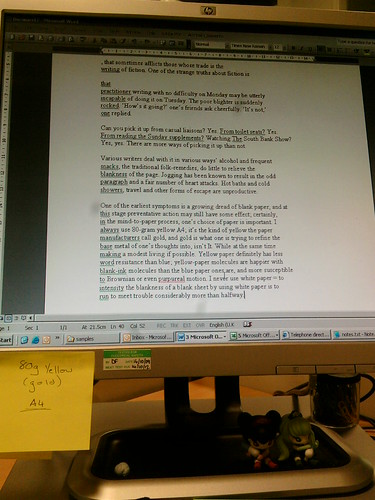
You’ll notice that i don’t call It by its right name. speaking its name might not actually bring it on but why take foolish chances. I’m talking about a certain sort of stoppage or ungoing, not infrequently an ongoing ungoing, that sometimes afflicts those whose trade is the writing of fiction. One of the strange truths about fiction is that practitioner writing with no difficulty on Monday may be utterly incapable of doing it on Tuesday. The poor blighter is suddenly rocked. ‘How’s it going?’ one’s friends ask cheerfully. ‘It’s not,’ one replied.

Can you pick it up from casual liaisons? Yes. From toilet seats? Yes. From reading the Sunday supplements? Watching The South Bank Show? Yes, yes. There are more ways of picking it up than not.

Various writers deal with it in various ways’ alcohol and frequent snacks, the traditional folk-remedies, do little to relieve the blankness of the page. Jogging has been known to result in the odd paragraph and a fair number of heart attacks. Hot baths and cold showers, travel and other forms of escape are unproductive.

One of the earliest symptoms is a growing dread of blank paper, and at this stage preventative action may still have some effect; certainly, in the mind-to-paper process, one’s choice of paper is important. I always use 80-gram yellow A4; it’s the kind of yellow the paper manufacturers call gold, and gold is what one is trying to refine the base metal of one’s thoughts into, isn’t It. While at the same time making a modest living if possible. Yellow paper definitely has less word resistance than blue; yellow-paper molecules are happier with blank-ink molecules than the blue paper ones are, and more susceptible to Brownian or even purpureal motion. I never use white paper - to intensity the blankness of a blank sheet by using white paper is to run to meet trouble considerably more than halfway.


from "Blighters Rock", The Moment under The Moment


the picture shows this year's quote on my work monitor, with post-it to prompt the sourcing of yellow paper.... the quote itself was then tweeted (in a chopped up, unfortunately messy fashion), though was one of those days where i went to work and had dinner at friends, so had little other option. and would help if twitter weren't blocked from work....and all the parts had actually gone in from my phone. so it goes.

Wednesday, 4 February 2009

peter morrison 2009

I posted bits of this on Twitter, i posted the whole extract on LiveJournal and Blogger. And intended to leave the physical piece of paper somewhere this evening. However, the weather has taken a turn, and unfortunately I decided that coming home was the more sensible option. But instead, I've written the passage on the back of a postcard, which I am going to send to a Hoban reading friend in Oslo.

Angelica's Grotto
Russell Hoban
Session Five

"I'm lost," said Klein.
"In what sense?" said Dr DeVere.
"In the sense of I don't know where I am."
"Can you elaborate?"
"I am of a people who have always been fearless navigators of the mind. The dead sail with us as we make our way from idea to idea, steering by the stars and sea-marks named by those before us. Such a wide, wide ocean! But always know where you are by the waves, by the swells; the winds blow from not the usual quarters. Black squalls come, and heavy seas, the stars are blotted out, the wind moans in the rigging. You suddenly realise that you might never make your landfall, you might drown. A great wave hits the boat and takes you with it, you feel yourself going down, down, down and then you don't know any more which way is up and you can't hold your breath a moment longer and the wild wide ocean fills your lungs and then you're gone: down among the dead men."
Dr DeVere kept respectfully silent for a few moments.
"It's good that you could get that out," he said.
"Is it? I almost don't know who I am. I try to think of how I came to this and it's hard to believe how it all began. I read this lousy piece in The Times and Boom! my world fell apart."
"Ronnie Lang said some good things in his time: one of them was, 'The breakdown can be the breakthrough .'"
"Depends on what you break through to, I should think."

Monday, 4 February 2008

peter morrison 2008

i am so badly organised this year. but managed to leave the following quote in GFT in glasgow. it was gone when i came out of film. never sure what that means. i wonder... what happens to the sheet of yellow paper?

Max stands there for what seems a long time. The shapes of black keep moving and changing. The way they do it scares him. He'd like to think it's his mind playing up but this feels as this is coming from somewhere else. The black shapes are as sharp as razor blades. Max fears that if he makes a wrong move blood will come out of his eyes and ears and nose and mouth. What would be a wrong move? A wrong thought? He plays close attention to the shapes of black. The distances between them are not always the same. A Woman He can't see touches his arm and says, 'Are you all right?'

'I'm OK, Thanks' he says. 'I was just trying to remember if I turned off the cooker.'

'And did you?'

'Not sure but I'll find out when I get home.'

'Good luck,' says the woman, and she's gone.

Is one of the black shapes moving away from the others? Is it something recognisable? Suddenly the world comes back. With a stench of desolation. It smells like a backed-up toilet in an empty house with broken windows. Out of the corner of his eye Max sees something following him. Is it a dog? A cat? It's a little man, black as ebony, long body, very short arms and legs, large head, big ugly baby-face. He's inching along on his belly like a dog that's been run over. Max looks around. Lots of foot traffic but no one's stepping on the dwarf. Nobody is taking any notice at all. The smell is almost making Max throw up but he wants to do the decent thing. He says to the dwarf, 'Are you all right?'

'Closer,' says the dwarf. His voice is like dead leaves skittering on the floor of that empty house with the backed-up toilet.


from Her Name Was Lola

Sunday, 4 February 2007

peter morrison 2007

the first paragraph below i left on paper in the arches in glasgow, and posted the full thing on my blog/journal here and here.

There are green turtles whose feeding grounds are along the coast of Brazil, and they swim 1,400 miles to breed and lay their eggs on Ascension Island in the South Atlantic, half way to Africa. Ascension Island is only five miles long. Nobody knows how they find it. Two of the turtles at the Aquarium are green turtles, a large one and a small one. The sign said: "The Green Turtle, Chelonia mydas, is the source of turtle soup..." I am the source of William G. soup if it comes to that. Everyone is the source of his or her kind of soup. In a town as big as London that's a lot of soup walking about.

How do the turtles find Ascension Island? There are sharks in the water too. Some of the turtles get eaten by sharks. Do the turtles know about sharks? How do they not think about the sharks when they're swimming that 1,400 miles? Green turtles must have the kind of mind that doesn't think about sharks unless a shark is there. That must be how it is with them. I can't believe they'd swim, 1,400 miles thinking about sharks. Sea turtles can't shut themselves up in their shells as land turtles do. Their shells are like tight bone vests and their flippers are always sticking out. Nothing they can do if a shark comes along. Pray. Ridiculous to think of a turtle praying with all those teeth coming up from below.

Mr. Meager, manager of the shop and the source of Meager soup stood in front of me for a while. When I noticed him he asked me if I'd got something on my mind. Green turtles, I said. Was that something we'd subscribed, he wanted to know. No, I said, it was the source of turtle soup. He went away with a hard smile.

It's hard to believe they do it by observing the angle of the sun like a yachtsman with a sextant. Carr doubts it and he's about the biggest turtle authority there is. But that's what penguins do on overland journeys. They're big navigators too. I think of the turtles swimming steadily against the current all the way to Ascension. I think of them swimming through all that golden-green water over the dark, over the chill of the deeps and the jaws of the dark. And I think of the sun over the water, the sun through the water, the eye holding the sun, being held by it with no thought and only the rhythm of the going, the steady wing-strokes of the flippers in the water. Then it doesn't seem hard to believe. It seems the only way to do it, the only way in fact to be, swimming, swimming, the eye held by the sun, no sharks in the mind, nothing in the mind. And when they can't see the sun, what then? Their vision isn't good enough for star sights. Do they go by smell, taste, faith?

from Turtle Diary


i've only been reading hoban for a few years, think this is my 3rd sa4qe? i worked my way through all the bloomsbury books with the matching covers, not really realising turtle diary would become hard to get. but by the time i was ready to just get it despite it not matching the others, the only copy i had actually seen in the shops was gone. so i finally got round to buying it second hand about a month ago, and read it in the last couple of weeks. normally its the humour, the sense of the weird that creeps in that gets me with russell's work, though i acknowledge the darkness in his work. reading turtle, i guess it hit me in the rut, and turning that last page i was left with a sense of melancholy, a need to release my own turtle. since reading it the whole idea of "soup" has become a running gag between me and a friend - you have a choice, accept new ideas and keep moving, or become soup.

i avoided reading the related posts before i went out, not entirely sure why, but i didn't want it to influence me. very weird to then find that the same quote has already been used. and to think i nearly went for the one about the playboy in the shark cage and the parallels between fetishism, or william g's speculations about shamanism and the turtle as his spirit animal.

anyway, a good day to you all, and may you avoid being soup good and long!

Saturday, 4 February 2006

peter morrison 2006

hello all. happy russ's birthday.

i sat last night and wrote out my SA4QE on one of the nice sheets of yellow paper i liberated from work. carried it around all day with me. took me awhile to decide where to put it. then as i headed towards HMV it hit me. leave it in the world cinema section, and given the nature of my quote, preferably with a horror film. i opted for the japanese ring trilogy box set, i felt given the themes of linger awhile that was a very appropriate place to leave a quote about a video-generated hopping thing...

Everything was going round and round with the ground sometimes tilting up and sometimes down while out of the corner of my eye I saw some great big hopping thing coming after me. I sprinted down Cecil Court, dodged through the traffic in St. Martin's Lane with the thing close behind, made a sharp right towards the Coliseum, then left and left again and so on trying to lose it but when I reached the lab it was still hot on my heels. Once I got inside I phoned the police while the hopping thing did its best to come through the wall. Scared? I didn't know whether to shit or go blind so I just closed one eye and farted and hoped for better times. It took about an hour and a whole lot of black coffee before the thing left off thumping and squelching and went back to wherever it lives.

from Linger Awhile

Friday, 4 February 2005

peter morrison 2005

i left the following quote at the UGC, Renfrew St, Glasgow, left in a cup holder during a showing of the film Closer:


More and more i find that life is a series of

disappearances

followed usually but not always by reappearances;

you disappear from your morning self

and reappear as your afternoon self;

you disappear from feeling good

and reappear feeling bad.

And people, even face to face

and clasped in each other's arms,

disappear from each other.

from Fremder


-that is actually a somewhat apt quote for Closer, though on reflection, i can see it being the perfect choice of film for Russell, being so london based, but while watching it i became struck of the parallels with her name was lola. the opening sequence of the film shows a writer dan (=max; also in search of "page one") spotting his destiny girl alice (=lola), but then he is distracted by anna a photographer (=lula mae in a gallery), and then there is nice reliable dr. larry in the background (=basil lawyer). really it is a vague comparison, but for me the core idea really is the discovery of dan's destiny girl and his subsequent inability to hold on to her and remain true to her.

which is perhaps ironic given that my second quote is from her name was lola, though this is a virtual quote rather than physical quote, so that might be cheating?

He's looking for page one.

This is a bit like trying to retrieve a coin that's

fallen down a grating.

Is that it, that faint gleam in the darkness?

Not sure.

He lowers weighted strings and chewing gum and brings up bottle caps.

'Blighter's rock?' says Max's mind.

'I am not rocked,' says Max.

He avoids the proper name of that condition in which writers are unable to write.
from Her Name Was Lola


which should have been posted on my blog as a nice yellow back grounded image that I made specially. However, thanks to my poor internet/modem connection, I've had to opt for just a text post for now - but I am determined to post this image at some point! Anyway - its posted here for the moment (and my review of lola for anyone interested is posted here) and was posted while my image loading doo-daa was working...)

happy birthday russell

peter


ps: i also found this comic strip on the 4th appropriately enough - and thought they might be a suitable gift for celebrants of tentacles:

http://www.chrisbishop.com/her/archives/her2.html

http://www.chrisbishop.com/her/archives/her61.html

-enjoy :)